Table of Contents
- Aura Home vs Luxury Boutique Decor: The Quick Comparison
- What Actually Defines Luxury Boutique Decor
- High-End Home Textiles: Pricing, Durability and Cost Per Year
- Finding the Best Luxury Home Decor Online Stores
- How to Style Luxury Home Decor Across a Whole Room
- Where Mass-Market Homewares Win, and Where They Don't
- Frequently Asked Questions
Last Updated: September 29, 2026
Aura Home vs Luxury Boutique Decor: The Quick Comparison
Walk into a mass-market homewares store and a luxury boutique decor showroom, and the difference is often invisible at arm's length. Pick up a quilt cover from each, though, and your hands tell a different story. This comparison from Casa Sereno breaks down what separates mass-market homewares from genuine luxury boutique decor.

| Factor | Mass-Market Homewares | Luxury Boutique Decor |
|---|---|---|
| Price point | Lower upfront cost | Higher upfront cost |
| Material quality | Blended fibres common | Natural fibres, denser weave |
| Lifespan | Often replaced within a year or two | Built to last several years |
| Design consistency | Trend-driven ranges | Timeless, curated collections |
| Shopping experience | High volume, self-serve | Consultative, styled displays |
What Actually Defines Luxury Boutique Decor
Luxury boutique decor is home décor produced in smaller runs with a focus on material quality, authentic craftsmanship, and a consistent design aesthetic rather than volume and trend cycles. It is defined less by price tag than by how the piece is made and how long it lasts.
Material Quality: What You Can Check With Your Own Hands
Material quality is the fastest way to separate genuine luxury boutique decor from a mass-market lookalike, no lab needed, just a minute with the product.
- Fibre content: Natural fibres such as cotton, linen, silk, and wool behave differently to synthetic blends. Check the label, then check the feel.
- Weave density: Hold the fabric up to light. A dense weave blocks more light and generally wears better.
- Weight: A heavier throw or quilt cover usually signals more fibre per square metre, which affects both drape and durability.
- Stitching: Look at the seams. Even, tight stitching with no loose threads is a reliable signal of care in production.
Authentic Craftsmanship vs Marketing Language
Authentic craftsmanship shows up in details that cost money to get right: pattern matching across seams, reinforced corners, and consistent colour across a full set. Marketing language tends to be vague, "artisan-inspired" or "hotel-quality" carry no defined meaning.
High-End Home Textiles: Pricing, Durability and Cost Per Year
High-end home textiles cost more upfront but often cost less per year of use, because they are replaced less often. That is the budget-to-luxury ratio in one sentence.
- Taj Queen Quilt Cover Set - White ($299.00): soft, durable cotton in a clean Hampton look that suits most colour palettes.
- Lopez Universal Set - White ($299.00): a beautifully textured cotton bedspread set that slots into a room without a full redecorate.
- Marino Pillowcase ($35.00): textured cotton pillowcase designed to pair with the sets above.
- Aura Dupin Silk ($25.00): a silk throw that adds textural contrast to a cotton bed.
Finding the Best Luxury Home Decor Online Stores
The best luxury home decor online stores share three traits: transparent material specifications, real product photography rather than renders, and a returns policy that removes the risk of buying sight unseen.

When comparing online stores, run this checklist:
- Does the listing state the fibre content, not just "premium fabric"?
- Are there photos of the product in a styled room, not just on white?
- Is the return window stated plainly, including who pays return shipping?
- Are dimensions given in centimetres for every size option?
- Does the store show the full collection so you can judge whether pieces work together?
How to Style Luxury Home Decor Across a Whole Room
Styling luxury home decor across a room works best in layers: a neutral base, one or two statement pieces, and lighting that changes how the textures read. Start with the largest surface and work outward, but styling is only half the job. The other half is keeping those materials looking styled for years.
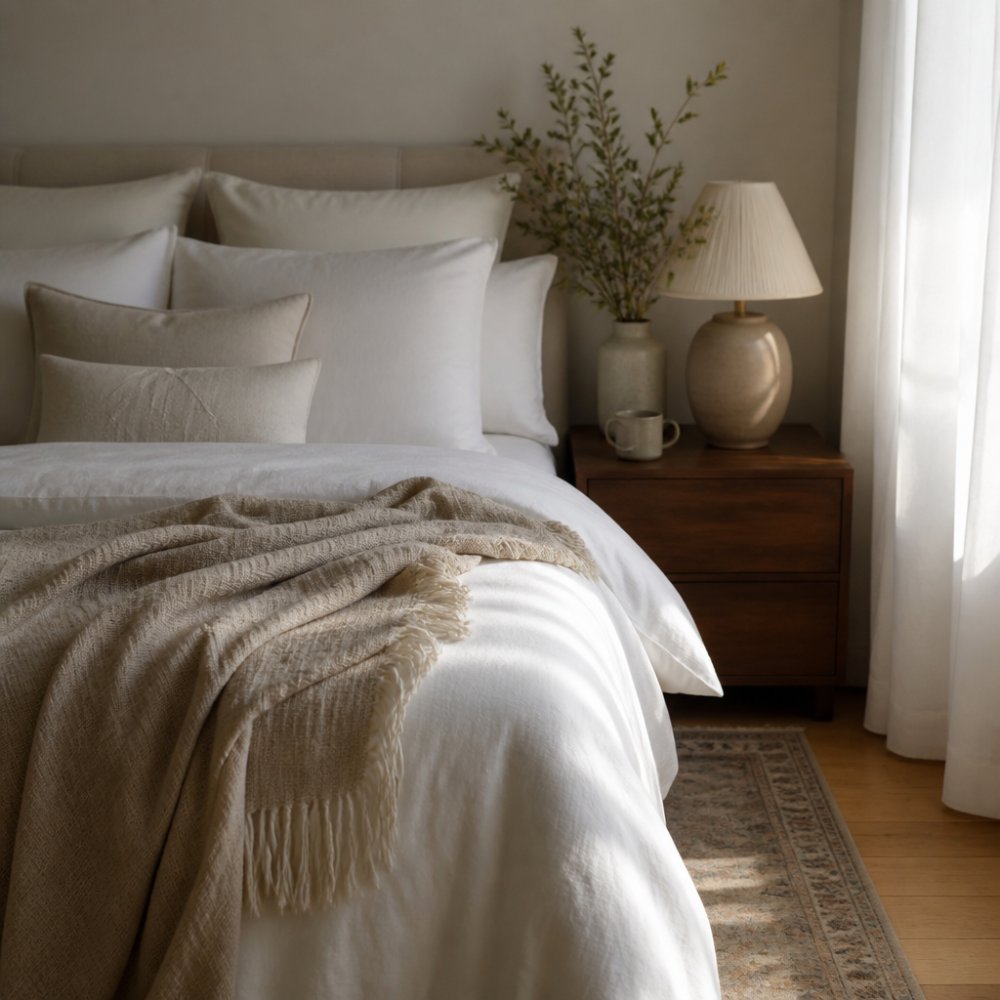
The sequence that works:
- Set the base. Choose bedding or upholstery in a neutral tone. White cotton is forgiving and makes everything layered on top look deliberate.
- Add textural contrast. Pair smooth cotton with a rougher weave or a silk throw. Contrast is what stops a neutral room feeling flat.
- Introduce one statement piece. A single strong object per room reads as considered. Three competing ones read as clutter.
- Layer the lighting. Atmospheric lighting at two or three heights, a lamp, a wall light, a candle, changes the room after dark.
- Finish with small objects. A mug, a tray, a book. These are the details that make a space feel lived in rather than staged.
Caring for Luxury Materials So They Stay Looking Styled
The materials themselves need a maintenance rhythm, and getting it wrong is the fastest way to undo the investment. A few working rules by material:
- Linen and cotton bedding. Wash at 30-40°C on a gentle cycle with a mild detergent. High heat breaks down fibres and causes pilling. Line dry in shade rather than direct sun, which fades natural dyes and weakens yarn. Rotate two sets so each gets half the wash cycles.
- Silk throws and cushions. Hand wash or use a delicate machine cycle at 30°C with a pH-neutral detergent. Never wring silk, press water out between towels and dry flat. Store folded, not hung, to avoid stretching.
- Brass and metal hardware. A dry microfibre cloth for daily dust, and a mild soap-and-water wipe for fingerprints. Avoid abrasive polishes, which strip the lacquer that stops brass tarnishing in the first place.
- Ceramics and stoneware. Check whether the piece is dishwasher-safe before assuming. Hand-painted or reactive-glaze finishes often are not, and repeated dishwasher cycles dull the surface.
- Wool rugs and throws. Vacuum on low suction without a beater bar. Rotate the rug every few months so foot traffic wear is even, and address spills immediately with a clean, dry cloth rather than rubbing.
The Budget-to-Luxury Ratio in Practice
Not every piece needs to be a boutique buy. Spend where your skin and hands meet the product daily, and save on the pieces that are purely visual.
- Spend here: bedding you sleep in, towels you dry with, the mug you use every morning, the sofa you sit on. These take the most wear and reward material quality most.
- Mix here: cushions, throws, table linens. One boutique piece alongside mass-market basics reads as curated rather than expensive.
- Save here: seasonal decor, trend-driven accents, anything you would happily replace in a year. Mass-market is genuinely the right call.
Where Mass-Market Homewares Win, and Where They Don't
Mass-market homewares win on price, immediacy, and range, walk in, compare twenty options, leave with something today. For a spare room, a rental you will leave in a year, or a trend you want to try without commitment, that is a genuinely good deal.

A Side-by-Side Look at Material Quality
Price tags tell you little on their own. The clearest way to judge mass-market against luxury boutique decor is to compare physical specifications in the same product category, a framework you can apply in any store or listing.
| Specification | Typical mass-market | Typical luxury boutique |
|---|---|---|
| Fibre content | Poly-cotton blends, often 50/50 or higher synthetic | 100% cotton, linen, silk, or wool |
| Fabric weight (GSM) | Lighter, often 100-150 GSM for bedding | Denser, commonly 200-400 GSM depending on type |
| Weave | Looser percale or basic sateen | Tighter percale, long-staple cotton, or jacquard |
| Stitching | Single-stitched seams, loose thread ends common | Double-stitched, reinforced corners, pattern-matched seams |
| Wood type (furniture) | MDF, particleboard, or rubberwood veneer | Solid oak, walnut, teak, or ash |
| Manufacturing origin | Often undisclosed or multi-country | Usually stated, with a traceable supply chain |
| Colour consistency | Batch variation between seasons | Consistent across a collection and reorders |
The Budget-to-Luxury Ratio, Worked Through
- Daily contact items, bedding, towels, the mug you reach for every morning, the sofa you sit on. These take the most abrasion and washing. Paying more upfront usually works out cheaper per year of use.
- Weekly contact items, cushions, throws, table linens. One boutique piece mixed with mass-market basics gives the room a considered feel without the full cost.
- Seasonal or trend items, decorative accents, holiday decor, anything you would replace within a year. Mass-market is the rational choice here.
That is where the budget-to-luxury ratio flips: daily-use items reward paying more upfront, while decorative extras cost you nothing but a season.
Frequently Asked Questions
What defines luxury boutique decor compared to mass-market brands?
The clearest differences sit in material, construction and range size. Boutique labels typically use natural fibres such as cotton, silk and wool, keep collections small, and repeat core designs across seasons rather than chasing every trend. Mass-market ranges turn over faster and often blend synthetic fibres to hit a lower price. Check the fibre content, the stitching at seams and hems, and whether the same design is still sold a year later. Those three checks tell you more than any brand claim.
Are boutique home decor pieces better for long-term interior styling?
They usually hold their place in a room for longer because they are built around neutral palettes and natural texture rather than seasonal colour. A white cotton quilt cover set or a silk throw works with almost anything you add later, so you are not redecorating around a trend. The trade-off is a higher upfront cost. If you plan to keep a piece for five years or more, the cost per year often lands below replacing a cheaper version twice.
What should I look for when sourcing high-end home textiles?
Start with the fibre content on the label, then check the weave density by holding the fabric up to light. Look at how seams are finished, whether patterns line up across joins, and whether the item is sold as a set or as separates. For bedding, confirm the size against your actual quilt and mattress, since a queen set from one label may not match another. Care instructions matter too: a textile that needs dry cleaning every few weeks costs more than the ticket price suggests.
How do I know a piece will still look current in two years?
Judge it without the styling. If a cushion, throw or pillowcase still looks good on a plain background with no props around it, it will survive a change of taste. Pieces in white, stone, sand or charcoal, and those with texture rather than print, age best. Ask yourself whether the item would work in a second room in your home. If the answer is yes, it is a core piece rather than a trend purchase.
Is it worth paying more for a single statement piece instead of a full room refresh?
Often yes, particularly if you rent or are not ready to commit to a full redesign. One well-made piece, such as a silk throw or a textured cotton pillowcase, changes how a room reads without new furniture or paint. Build the room one layer at a time: bedding first, then a throw, then tableware or accessories. You can see how each addition sits in your actual light before spending on the next.