

Table of Contents
- The Rule of Three: Your Coffee Table Styling Foundation
- How to Arrange Decor on a Coffee Table Step by Step
- Coffee Table Styling Tips for Every Table Shape
- Best Indoor Plants for Living Rooms: What Works and What Doesn't
- Choosing Coffee Table Books That Earn Their Place
- Minimalist vs. Maximalist Coffee Table Styling
- Budget-Friendly and Functional Styling That Still Looks Elevated
- Conclusion
Last Updated: August 22, 2026
The Rule of Three: Your Coffee Table Styling Foundation
Coffee table styling is the art of arranging decorative objects to create a cohesive, visually balanced focal point. The Rule of Three is the single most reliable principle for achieving this. The human eye finds odd-numbered groupings more dynamic than even ones. Three objects of varying height, texture, and scale create visual tension that draws the eye across the arrangement rather than landing on a single static point.
This guide from Casa Sereno breaks down exactly how to style a coffee table with books and plants, covering everything from tray selection to pet-safe greenery.

Applying the 2/3 Rule for Visual Balance
The 2/3 rule takes the Rule of Three further: your arrangement should occupy roughly two-thirds of the table surface, leaving one-third clear. That empty space makes the styled section feel considered rather than cluttered. Group your three elements (books, a plant, and a sculptural object or tray) within a defined zone, leaving the remaining surface open for functional use: a cup of tea, a remote, a glass of water.
How to Arrange Decor on a Coffee Table Step by Step
Arranging decor on a coffee table follows a repeatable process: anchor with a tray, build height variation, and finish with a living element.
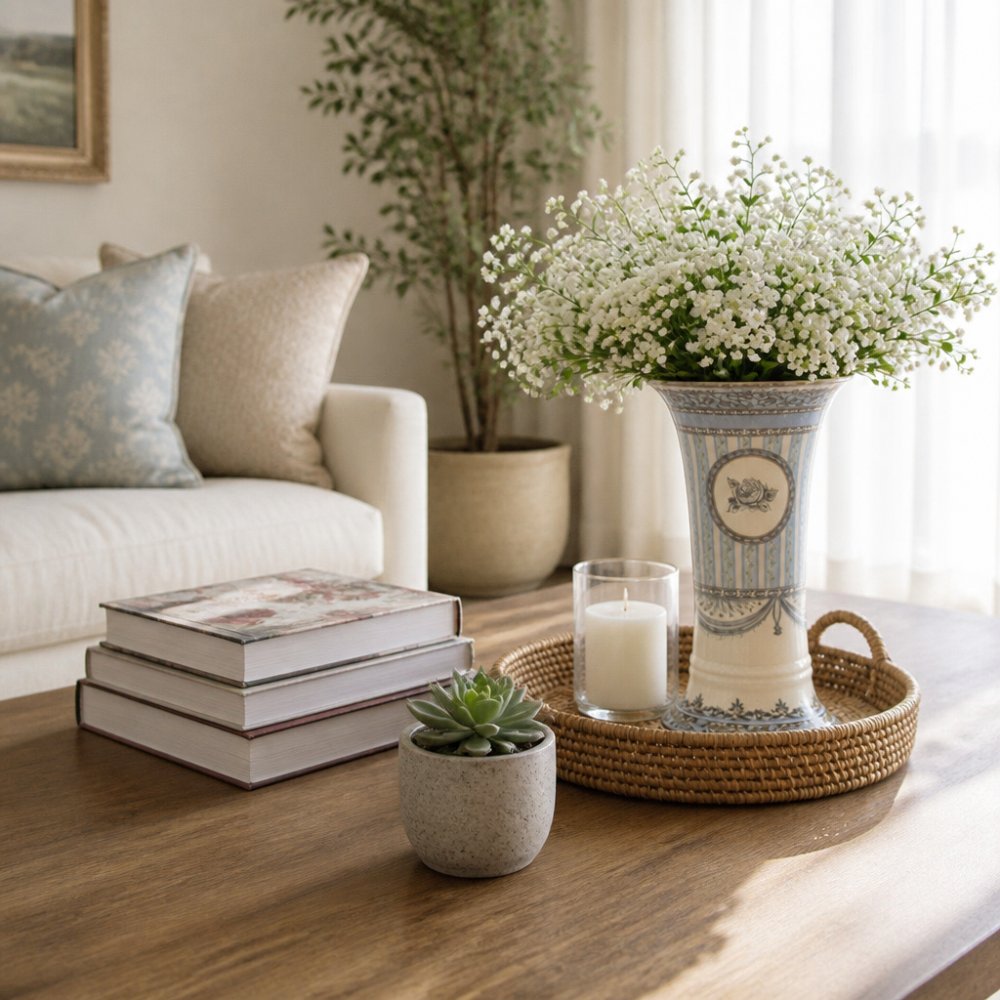
Step 1: Clear the table completely. Start fresh. Styling over existing clutter produces clutter with better objects on top.
Step 2: Place your tray first. The tray anchors the arrangement and defines its footprint. A round tray suits round tables; a rectangular tray works for longer surfaces.
Step 3: Add your tallest element inside or beside the tray. A vase, a tall candle, or a plant provides the vertical anchor. The Vase from Casa Sereno works particularly well: its layered, sculptural quality adds height without visual weight.
Step 4: Stack your books. Two to three large-format books stacked horizontally create a plinth for smaller objects and introduce colour through their spines or covers.
Step 5: Add a low, textural element. A small potted plant, a cluster of stones, or a small bowl completes the trio, providing visual grounding.
Step 6: Edit. Step back and remove anything that competes for attention without earning it. One strong object beats three mediocre ones.
Step 7: Adjust for function. Shift the arrangement so at least one-third of the table remains clear for daily use.
Choosing and Placing a Decorative Tray
A decorative tray corrals smaller objects into a unified group and defines the boundary of your arrangement. Without a tray, a collection of small objects reads as scattered. With one, the same objects read as curated.
Material matters for cohesion. Woven rattan trays suit relaxed coastal or organic interiors. Lacquered or marble-effect trays lean formal. Raw timber trays work across almost every interior style. Choose a tray that contrasts slightly with your table surface: a light tray on a dark table, or a textured tray on a smooth one.
Size is critical. The tray should be large enough to hold your key objects without crowding them, but not so large that it dominates the table. A tray that fills more than half the table surface tips the balance from styled to overwhelming.
Layering Height and Texture for a Curated Vignette
Height variation separates a flat arrangement from a proper vignette. Aim for three distinct levels: tall, mid, and low. The tall element (a vase, a tall candle, a plant with upright growth) anchors the eye. The mid element (a stack of books, a medium candle, a small sculpture) bridges the transition. The low element (a trailing plant, a small dish, a flat decorative object) grounds the composition.
Texture adds the tactile dimension that photographs well and reads well in person. Pair smooth glass with rough linen, or polished ceramic with raw timber. The Blue Edge Glass Vase introduces a coastal glass texture that pairs beautifully against matte or woven surfaces, adding colour and material contrast.

Element |
Height Role |
Texture Suggestion |
Example Object |
|---|---|---|---|
Anchor |
Tall |
Smooth or reflective |
Glass vase, tall candle |
Bridge |
Mid |
Matte or printed |
Stacked books, ceramic bowl |
Ground |
Low |
Natural or woven |
Potted plant, woven coaster |
Coffee Table Styling Tips for Every Table Shape
Table shape dictates the geometry of your arrangement. The shape of your table is the constraint most styling guides ignore, and it is the reason arrangements that look perfect in a mood board fail in an actual living room.
Round Tables
Round coffee tables require a centred or radial arrangement. A single tray or grouping placed in the middle, with objects radiating outward in balanced proportions, works best. Avoid rectangular trays on round tables: the geometry fights itself. For a round table, three objects arranged in a loose triangle within a round tray reads as intentional. Keep the arrangement compact; round tables typically have less surface area than rectangular ones.
Rectangular and Square Tables
Rectangular tables offer the most styling flexibility. You can divide the surface into zones: a styled section at one end, a functional zone in the middle, and an optional secondary arrangement at the other end for longer tables. This zoning approach is particularly useful in open-plan living areas where the coffee table is visible from multiple angles.
Square tables suit a centred arrangement or an offset grouping in one quadrant with the remaining surface left clear. Square tables often suit a more architectural, geometric arrangement: stacked books aligned with the table's edge, objects placed with deliberate right angles.
According to Better Homes and Gardens' interior styling guides, the most common mistake with rectangular tables is centring a single arrangement rather than creating zones, which leaves the ends of the table looking bare and unbalanced.
Best Indoor Plants for Living Rooms: What Works and What Doesn't
The best indoor plants for living rooms are those that thrive in the light conditions of your specific space, stay proportionate to the table surface, and require maintenance you will actually keep up with. A dead or struggling plant undermines the entire arrangement.
Climate-Conscious Plant Choices for Warmer Homes
Homes in warmer climates face specific challenges: higher ambient temperatures, lower humidity indoors when air conditioning runs continuously, and intense light through west-facing windows. Plants that thrive in cool, humid conditions often struggle without consistent care.
Plants that perform reliably in warmer indoor environments include:
- Pothos (Epipremnum aureum): tolerates low light and irregular watering; trailing varieties add organic quality
- ZZ plant (Zamioculcas zamiifolia): handles dry indoor air and infrequent watering; its upright, glossy leaves add sculptural interest
- Sansevieria (snake plant): thrives in bright indirect light and dry conditions; its architectural form suits both minimalist and maximalist arrangements
- Succulents: compact, low-maintenance, and available in a range of forms; suited to bright spots near windows
- Rubber plant (Ficus elastica): tolerates warmer temperatures; its large, dark leaves add drama
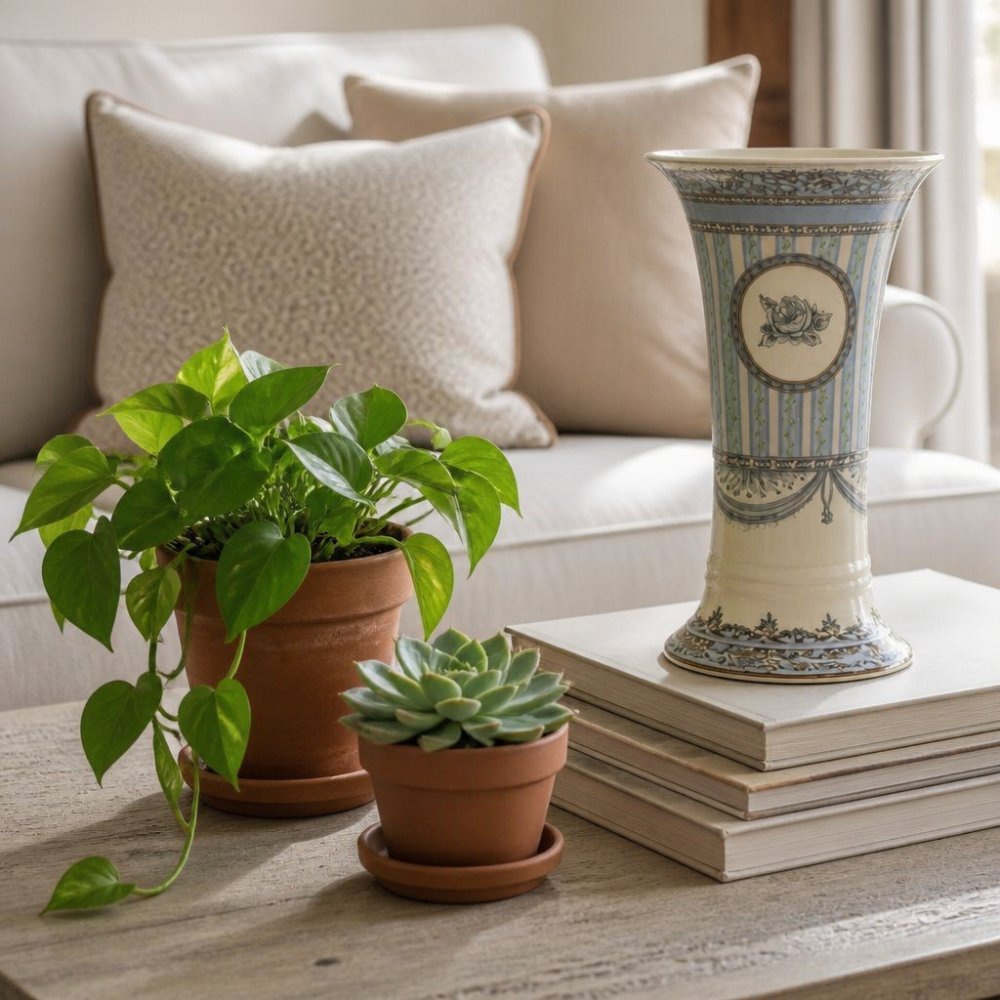
For air conditioning environments, avoid plants that require high humidity unless you are willing to mist them regularly. The Royal Botanic Gardens Victoria's indoor plant care resources provide climate-specific guidance on plant selection for Australian interiors.
Pet-Friendly Plant Options
Many popular styling plants are toxic to cats and dogs. Pothos is mildly toxic to pets if ingested. Peace lilies are highly toxic to cats. Sansevierias can cause gastrointestinal upset in dogs.
Pet-safe alternatives that still work visually on a coffee table:
- Spider plant (Chlorophytum comosum): non-toxic to cats and dogs; its arching, variegated leaves add texture
- Calathea: non-toxic, with striking patterned foliage; requires more humidity but rewards the effort
- Boston fern: non-toxic, though it needs consistent moisture; suits cooler, shaded spots
- Haworthia: a succulent-type plant that is non-toxic and extremely low-maintenance
- Parlour palm (Chamaedorea elegans): non-toxic and tolerates lower light conditions
As documented in ASPCA's toxic plant database, many common decorative plants pose real risks to household pets. Cross-referencing your plant choices against this list before purchasing is a practical step.
Choosing Coffee Table Books That Earn Their Place
Coffee table books are the most underused styling tool in the average home. Choose books based on three criteria: cover colour, spine colour, and subject matter. The cover and spine should complement your colour palette, not match it exactly. A warm terracotta spine on a neutral table adds warmth without demanding attention.
Subject matter matters because guests pick them up. Books on architecture, photography, food, travel, and art all read as intentional. Stack two to three books horizontally, with the largest at the bottom and the smallest on top. This creates a stable plinth that can support a small object: a candle, a small sculpture, or a single stem in a bud vase. The Oil Glass Bottle in Beige sits beautifully on a book stack, its warm glass tone adding material contrast.

Minimalist vs. Maximalist Coffee Table Styling
The minimalist versus maximalist question is not about which style is better, but which approach suits your interior, your lifestyle, and your tolerance for maintenance.
Minimalist coffee table styling uses three objects or fewer, prioritises negative space, and relies on material quality to carry the arrangement. This approach reads as intentional and sophisticated, but it demands that each object be genuinely interesting on its own.
Maximalist coffee table styling layers objects across the full surface, mixes textures and heights, and creates a sense of abundance and personality. Done well, it reads as curated and lived-in. The difference is editing: maximalism is not the absence of restraint, it is restraint applied differently.
If your living room already has significant visual activity (patterned rugs, gallery walls, statement furniture), a minimalist coffee table arrangement provides relief. If your room is quiet and neutral, a maximalist arrangement adds warmth and personality.
According to Architectural Digest's interior design guides, the most successful maximalist arrangements share a consistent colour palette across all objects, which prevents the layered look from tipping into visual chaos.
Budget-Friendly and Functional Styling That Still Looks Elevated
Good coffee table styling does not require expensive objects. The most important variables are proportion and editing, not price point.
Repurpose what you own. A ceramic mug, a piece of driftwood, a smooth stone, a small terracotta pot: these objects have texture, scale, and authenticity. Arrange them using the same principles (height variation, the Rule of Three, a tray to anchor) and the result is cohesive.
Invest selectively. One quality object lifts an entire arrangement. A well-made glass vase alongside op-shop books and a propagated cutting reads as intentional. The Glass Decanter in Clear at $50 is a considered investment that works across multiple arrangements.
DIY tray options. A timber offcut, a slate tile, or a vintage tray from a second-hand shop performs the same anchoring function as a designer tray.
Propagate plants. A pothos cutting in a glass jar of water is both functional and visually appealing. It costs nothing and introduces the living element that makes coffee table styling feel genuinely inhabited.
Approach |
Cost Level |
Effort |
Best For |
|---|---|---|---|
Repurpose existing objects |
Low |
Low |
Renters, first-time stylists |
One quality anchor piece |
Medium |
Low |
Anyone wanting longevity |
DIY tray + propagated plant |
Very low |
Medium |
Budget-conscious stylists |
Full curated arrangement |
Medium-high |
Medium |
Permanent homes, gifts |
Build function into the arrangement from the start: keep one clear zone, use a tray that can be lifted and moved, and choose plants in pots that do not leak. A table that looks beautiful but cannot hold a cup of tea, a book you are reading, or a remote control will be restyled by daily life within a week.
Styling a coffee table with books and plants is one of those deceptively simple tasks that rewards a clear method. The objects matter less than the principles: height variation, the Rule of Three, a tray to anchor, and enough restraint to leave space for actual living. Casa Sereno's carefully curated collection of vases, glass decanters, and decorative accessories gives you the quality anchor pieces that make the difference. Sign up for 20% off your first order and start with one piece that earns its place.
Frequently Asked Questions
What is the 2/3 rule for coffee table styling?
The 2/3 rule means your decorative arrangement should cover roughly two-thirds of the table's surface area, leaving one-third clear. This creates visual balance without making the table feel cluttered or unusable. For a rectangular table, group your books, plant, and tray on one side or in the centre, keeping the remaining space open so the table still functions day to day.
How many books should you stack on a coffee table?
Two to four books work well for most coffee tables. Stack them horizontally with the largest book on the bottom and a smaller one on top. This creates height variation and a solid base for a small object like a vase or candle. Avoid stacking more than four books, as the arrangement starts to look precarious and draws attention away from the rest of your curated vignette.
Which indoor plants are best for low-light living rooms?
Pothos, peace lilies, zanzibar gems (ZZ plants), and cast iron plants all handle low-light conditions well and are widely available. For coffee table scale, opt for a small pothos in a simple pot or a compact ZZ plant. These varieties also tolerate the inconsistent watering that comes with busy households. If you have pets, check toxicity before purchasing, as peace lilies and pothos can be harmful to cats and dogs.
What are the most common coffee table styling mistakes to avoid?
The most frequent mistakes are overcrowding the surface, using objects that are all the same height, and ignoring the table's shape when arranging items. Placing everything flat removes visual interest. Mixing heights — a tall vase, a mid-height plant, and a low book stack — creates the layered look that makes a styled table feel intentional. Also avoid using purely decorative items if the table gets daily use; a tray keeps functional items contained and the arrangement intact.

