

Table of Contents
- What Makes Elegant Quilt Covers Worth the Investment
- Best Fabric for Quilt Covers: From French Flax Linen to Bamboo
- Choosing the Right Bed Size: A Quilt Cover Dimensions Guide
- How to Style a Bed Like a Professional
- Design Styles: Classic, Minimalist, and Contemporary Quilt Covers
- Caring for Premium Bed Linen to Make It Last
- Conclusion
Last Updated: August 21, 2026
The right quilt cover does more than keep you warm, it anchors your bedroom's aesthetic and, if chosen well, lasts a decade or more. This guide covers materials, sizing, styling, care, and why certain bedrooms feel like sanctuaries while others just feel like rooms.
What Makes Elegant Quilt Covers Worth the Investment
The biggest mistake people make when buying bedding is treating it like a consumable. A premium quilt cover used every night for seven years delivers a cost-per-use that most people find surprisingly low. Cheap bedding tends to pill, fade, and lose structural integrity after repeated washing. Premium bed linen, particularly pieces made from long-staple cotton, French flax linen, or bamboo, holds its shape and softness over hundreds of wash cycles.
Thread Count, Weave, and What Actually Affects Feel
Thread count is the number of threads woven per square centimetre of fabric. A higher count generally indicates a denser, smoother weave, but only up to a point. Beyond a certain density, manufacturers achieve higher numbers by twisting multiple thinner threads together, which can actually reduce breathability and softness.
What matters more is the quality of the fibre itself and the weave structure. A percale weave (a simple one-over, one-under construction) produces a crisp, cool feel ideal for warmer months. A sateen weave, where threads float over four or more before going under one, creates that lustrous, silky surface associated with luxury hotel bedding.
The real differentiators for elegant quilt covers are fibre length, weave integrity, and finishing. Long-staple fibres produce fewer loose ends, which means less pilling and a smoother surface that actually improves with washing.
Best Fabric for Quilt Covers: From French Flax Linen to Bamboo
Fabric choice is the single most consequential decision when selecting a quilt cover. Each material has a distinct character, and the best choice depends on your climate, your skin sensitivity, and the aesthetic you're building.
Fabric |
Feel |
Best Season |
Key Benefit |
Worth Noting |
|---|---|---|---|---|
French flax linen |
Textured, relaxed |
Year-round |
Breathable, gets softer with age |
Wrinkles naturally, that's the look |
Organic cotton (percale) |
Crisp, cool |
Warm months |
Durable, hypoallergenic |
Needs several washes to soften fully |
Sateen cotton |
Smooth, silky |
Cooler months |
Lustrous finish, drapes beautifully |
Less breathable than percale |
Bamboo |
Silky, lightweight |
Year-round |
Moisture-wicking, naturally hypoallergenic |
Can be less durable than linen |
Flannelette |
Soft, brushed |
Winter |
Warmth without weight |
Not suited to humid climates |
French flax linen has become the defining fabric of contemporary Australian bedroom aesthetics. It's breathable, temperature-regulating, and develops a beautiful patina over time. Bamboo is the standout choice for moisture-wicking performance and is naturally hypoallergenic. Organic cotton remains the benchmark for durability and washability.
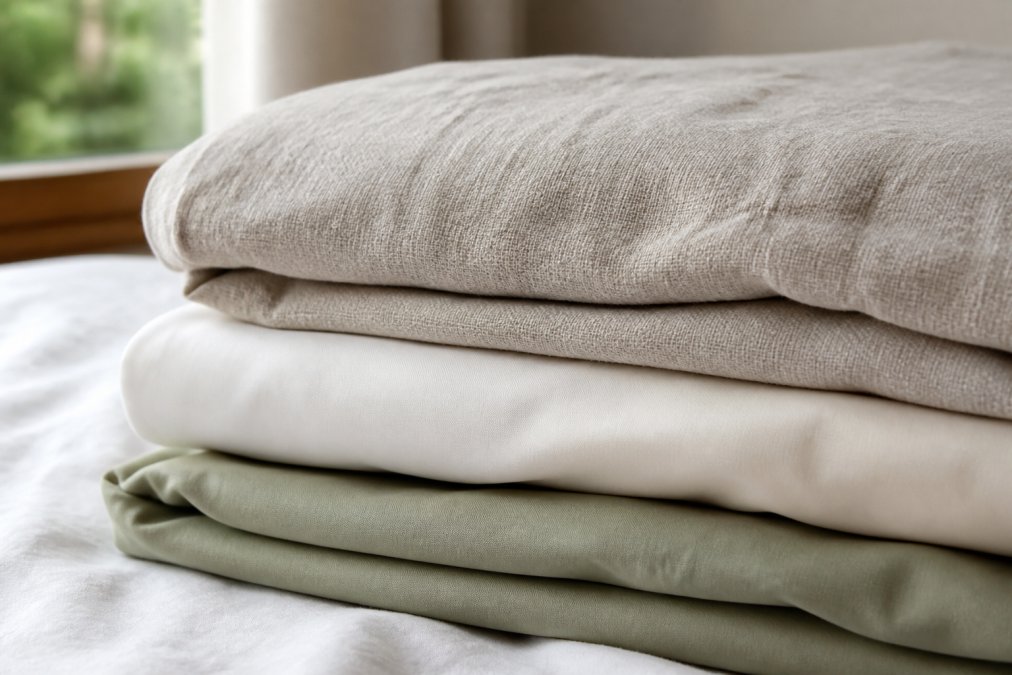
Seasonal Bedding: Matching Fabric to Climate
Seasonal bedding is practical temperature management. Many homeowners keep two quilt cover sets in rotation: a breathable option for warmer months and a warmer, heavier weave for winter.
For summer, French flax linen and bamboo are the clear choices. Both are breathable and moisture-wicking. Percale cotton is also strong, its open weave allows airflow in a way that sateen simply doesn't.
For cooler months, flannelette and sateen cotton provide warmth and a cocooning feel. According to Sleep Health Foundation Australia's guidance on sleep environment, bedroom temperature has a measurable effect on sleep quality, and bedding material is one of the most controllable variables.
Allergy-Friendly Bedding: What to Look For
For anyone with dust mite allergies, asthma, or sensitive skin, fabric choice is a health consideration. Bamboo is widely regarded as one of the most hypoallergenic bedding materials available. Its naturally antimicrobial properties make it resistant to dust mites and mould. Organic cotton, particularly GOTS-certified fabric, avoids the pesticide residues and chemical treatments found in conventional cotton processing.
French flax linen is also a strong choice for sensitive sleepers. Its breathability reduces the warm, humid microclimate that dust mites prefer, making it naturally resistant without chemical treatment.
Choosing the Right Bed Size: A Quilt Cover Dimensions Guide
Quilt cover sizing is one of the most common sources of confusion when buying bed linen online. Standard bed dimensions vary between manufacturers, and a quilt cover that fits one brand's queen mattress may not fit another's correctly.
Bed Size |
Mattress Dimensions |
Recommended Quilt Cover Size |
|---|---|---|
Single |
92 × 188 cm |
140 × 210 cm |
King Single |
107 × 203 cm |
165 × 210 cm |
Double |
138 × 188 cm |
180 × 210 cm |
Queen |
153 × 203 cm |
210 × 210 cm |
King |
183 × 203 cm |
245 × 210 cm |
Super King |
203 × 203 cm |
270 × 240 cm |
A quilt cover should always be slightly larger than the quilt insert itself to allow for comfortable movement. Many people size up one level, using a queen quilt cover on a double bed, for example, to achieve that generously draped look common in professional bedroom styling.
How to Style a Bed Like a Professional
Professional bed styling is less about perfection and more about intentional layering. Start with a fitted sheet in a neutral tone. Layer your quilt cover set over the top, leaving the top folded back approximately 30 centimetres to reveal the sheet beneath. Add euro pillows (65 × 65 cm) at the back, standard pillows in front, and finish with one or two decorative cushions. A folded throw at the foot of the bed adds texture without visual clutter.
The rule that most guides miss: restraint is the point. Every element should earn its place. A bed with too many cushions reads as busy, not luxurious.
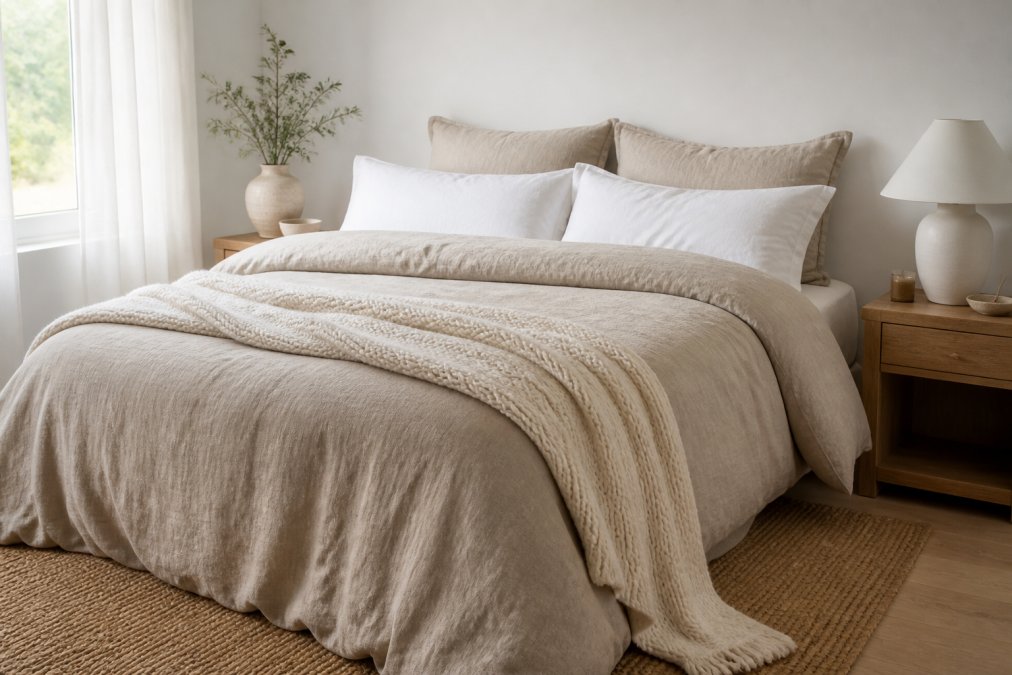
The Hotel-Look Bedroom: Layers, Texture, and Restraint
The hotel aesthetic is built on three principles: tonal consistency, textural contrast, and deliberate simplicity. You will almost never see a pattern-heavy quilt cover in a five-star hotel room. What you will see is a layered bedding ensemble in two or three tones, usually white, ivory, and one warm neutral, with texture doing the heavy lifting.
To replicate this at home: choose a quilt cover in white, stone, or soft grey as your base layer; add a coverlet or lightweight blanket in a complementary tone; use euro pillows in the same fabric family as your quilt cover; introduce texture through a linen throw or tufted cushion rather than pattern; keep the bedside surfaces clear.
According to The Australian Interior Design Awards' annual trend reports, tonal layering and natural textiles have been among the most consistently cited residential design preferences for several consecutive years.
Interior Design Psychology: Colour, Pattern, and Mood
Colour psychology in the bedroom operates differently from other rooms because the goal is restoration, not stimulation. Cooler tones (soft blues, sage greens, stone greys) are associated with calm and reduced cortical arousal. Warmer neutrals (oat, sand, terracotta) create a sense of physical warmth without the activating effect of brighter colours.
Pattern follows a similar logic. Geometric or high-contrast patterns can create visual tension that works against relaxation. Subtle textures, tonal embroidery, or the natural variation of French flax linen add visual interest without disrupting calm.
If you want a bedroom that genuinely feels like a sanctuary, resist trend-driven pattern and invest in texture instead. As research published in the journal Building and Environment has shown, the visual complexity of a sleep environment measurably affects how restful it feels to occupants.
Design Styles: Classic, Minimalist, and Contemporary Quilt Covers
Choosing a design style before you shop prevents the common mistake of building an incoherent bedroom aesthetic by accumulating pieces you loved individually but that don't work together.
Classic quilt cover sets lean on traditional craftsmanship: embroidery details, jacquard weaves, and restrained floral or damask patterns. They suit period homes and anyone who values permanence over trend. Minimalist designs strip everything back to material and proportion, the quality of the fabric becomes the statement. Contemporary quilt covers sit between the two, incorporating geometric detail or colour blocking while avoiding ornate complexity.
Casa Sereno offers curated collections with an emphasis on pieces that remain relevant across design cycles rather than chasing seasonal trends.
Caring for Premium Bed Linen to Make It Last
Caring for premium bed linen requires consistency. The most common way people shorten the life of a quality quilt cover is washing it incorrectly, too hot, with the wrong detergent, or dried at high heat.
General care principles: French flax linen should be washed in cool to warm water (30-40°C) on a gentle cycle and tumble dried on low or line dried. Cotton percale and sateen should be washed at 40°C on a gentle cycle; avoid fabric softeners, which coat the fibres and reduce breathability. Bamboo should be washed on a delicate cycle in cool water and air dried. Flannelette should be washed at 40°C on a gentle cycle and tumble dried on medium.
Store quilt covers folded inside a pillowcase from the same set. Rotate between two quilt cover sets if possible, giving each set a rest between uses extends the life of both significantly.
The challenge most people face when upgrading their bedroom is knowing where to start. Casa Sereno's curated bedding collections are designed to take the guesswork out of that process, offering carefully selected quilt cover sets in French flax linen, cotton, and bamboo across all standard bed sizes. With free shipping on orders over $150 and 20% off your first order when you subscribe, there's a practical reason to start now. Sign up and get 20% off your first Casa Sereno order, and begin building a bedroom that genuinely feels like a sanctuary.
Frequently Asked Questions
Q: What is the difference between a quilt cover and a duvet cover?
A: The terms are used interchangeably in Australia. Both describe a fabric shell that slips over a quilt or doona insert and fastens with buttons, a zip, or ties. 'Quilt cover' and 'doona cover' are the most common local terms, while 'duvet cover' is more common in the UK. The product itself is identical — the difference is purely regional language. When buying elegant quilt covers online, all three terms refer to the same bedding item.
Q: What fabric is best for luxury quilt covers?
A: French flax linen is widely regarded as the premium choice for year-round comfort — it's breathable in summer and insulating in cooler months, and it softens with every wash. Organic cotton percale suits those who prefer a crisp, cool feel, while bamboo fabric is exceptionally soft and moisture-wicking, making it ideal for warmer climates. Satin weaves add a lustrous finish for a more formal bedroom aesthetic. The best fabric depends on your climate, skin sensitivity, and preferred texture.
Q: How do I choose the right quilt cover size for my bed?
A: Standard bed sizes in Australia are: Single (92 × 188 cm), King Single (107 × 203 cm), Double (138 × 188 cm), Queen (153 × 203 cm), King (183 × 203 cm), and Super King (203 × 203 cm). Always match your quilt cover to your bed base size, not your mattress depth. A cover sized for a Queen bed will drape evenly over a standard Queen mattress. If your mattress is particularly deep (over 35 cm), check the product's drop measurement before purchasing.
Q: How often should you replace your quilt cover?
A: A well-made quilt cover from quality fabric — organic cotton, French flax linen, or bamboo — should last five to ten years with proper care. Signs it's time to replace include persistent pilling, fabric thinning, fading that washing can't restore, or fastenings that no longer hold. Buying a higher-quality bedding ensemble upfront and following correct care instructions significantly extends its lifespan, making the cost-per-use far lower than replacing cheaper covers every one to two years.

