

Table of Contents
- How to Mix Textures in a Living Room: The 7-Step Method
- Step 1: Build a Neutral Color Palette First
- Step 2: Layer Different Textures From the Ground Up
- Step 3: Balance Patterns and Textures in Home Decor
- Step 4: How to Style Decorative Cushions Like a Stylist
- Step 5: Bring In Natural Materials: Rattan, Wood and Stone
- Step 6: Balance Soft and Hard Surfaces for Visual Weight
- Step 7: Create a Collected Look Without Clutter
- Frequently Asked Questions
Last Updated: October 3, 2026
How to Mix Textures in a Living Room: The 7-Step Method
Learning how to mix textures in living room spaces is the fastest way to make a room feel designed rather than assembled. The colours work, the layout works, but something still feels unfinished. That "something" is usually texture.
You do not need to start over. This 7-step method works with what you already own.
Start With What You Already Own
Before buying anything, pull every cushion, throw, rug and accessory into one spot.
You will usually find one of two problems:
- Everything is the same texture (often all smooth cotton or all synthetic)
- The textures clash because there is no shared colour holding them together
Most rooms fail on the first point. A sofa in smooth linen, cushions in smooth cotton and a flat weave rug give the eye nothing to rest on. Texture creates depth, and depth makes a room feel finished.
The fix is rarely a full redecorate, usually two or three new pieces that add contrast.
Design Institute of Australia on interior styling practice
Step 1: Build a Neutral Color Palette First
A neutral base lets texture do the talking. When every surface competes in colour, texture gets lost.
Start with two or three neutral tones across your largest pieces: sofa, rug, curtains and walls. Think warm whites, oatmeal, stone, taupe or soft grey.
Then add one or two accent colours in smaller pieces. A blue velvet cushion, a terracotta throw or a timber side table carries colour without overwhelming the space.

Texture only reads clearly against a calm background, so get the palette right first and every texture you add afterwards will stand out.
Step 2: Layer Different Textures From the Ground Up
Build texture from the floor upward: rug, sofa, cushions and throws, then accessories.
Each layer should differ from the one below it.
A simple rule: no two touching surfaces should share the same finish. Rough next to smooth. Shiny next to matte. Looped next to flat.
Here is how the layers typically break down:
| Layer | Smooth Option | Textured Option |
|---|---|---|
| Floor | Flat weave rug | Chunky wool or jute rug |
| Seating | Linen sofa | Boucle or velvet armchair |
| Cushions | Cotton | Velvet, lace or wool |
| Throws | Fine knit | Chunky weave or fringed |
| Accessories | Glass, metal | Rattan, timber, stone |
You do not need every layer to contrast. Three or four well-chosen differences are enough.
Step 3: Balance Patterns and Textures in Home Decor
Balancing patterns and textures in home decor comes down to one principle: the busier the pattern, the calmer the texture.
A bold floral cushion works best against a plain velvet or linen base, and a subtle stripe sits happily next to a heavily textured weave.
A workable ratio for most living rooms:
- One large-scale pattern (a rug or a statement cushion)
- One small-scale pattern (a stripe, check or fine print)
- Two or three solid textures (velvet, wool, linen, rattan)
- One natural material for grounding (timber, stone or jute)
If a room feels chaotic, remove the smallest pattern first. It is almost always the culprit.
Step 4: How to Style Decorative Cushions Like a Stylist
Knowing how to style decorative cushions is the quickest texture win in any living room: they are cheap to change, easy to layer and instantly visible.
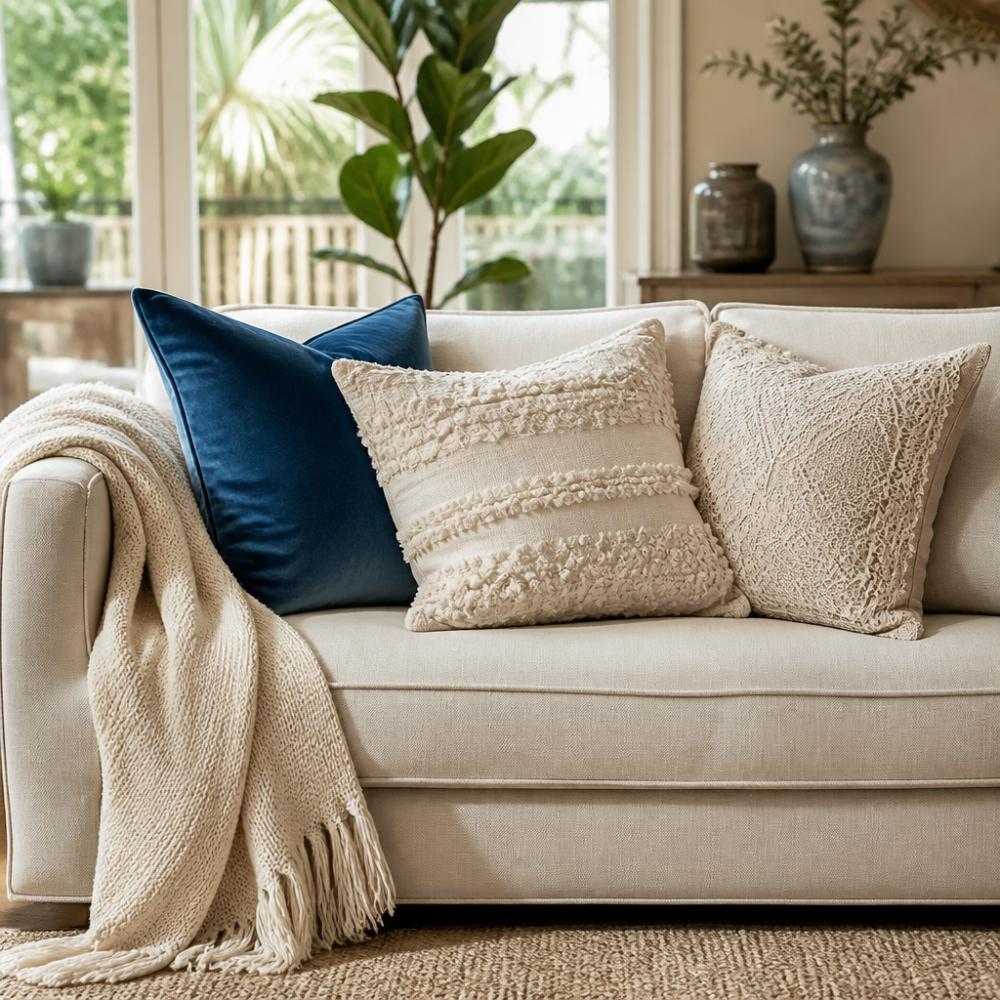
Work in odd numbers, mix at least three textures, and vary the sizes. Start with the largest at the back, then layer smaller ones in front: a 55cm base, a 45cm middle and a 30cm accent is a reliable formula.
For texture, pair one smooth fabric with one heavily textured piece and one delicate piece. Our Farmhouse Cushion brings a soft cotton weave that sits well against smoother fabrics. The Velvet Cushion Feather Filled - Blue adds a rich, light-catching finish, and the Elodie Lace Cushion introduces a fine, intricate layer that stops the grouping from feeling heavy.

Three textures, one palette, odd numbers. That is the foundation.
Match the Cushion Fabric to How the Room Is Used
A cushion you have to fluff every time someone sits down ends up on the floor. Match the fabric to the room's real use:
- High-traffic family rooms: choose durable, forgiving fabrics, cotton canvas, wool, linen blends, or performance weaves. Velvet and silk look beautiful but show crushing and marks quickly under daily use.
- Formal or occasional seating: velvet, silk and lace are fine here because they are not sat on every day. They catch light and add the luxury layer that durable fabrics cannot.
- Homes with pets or children: tight weaves and shorter piles resist snagging. Loop textures and loose lace are the first to pull.
Scale the Cushion Count to the Sofa
The three-cushion formula works on a two-seater. On a larger sofa it looks sparse. A practical guide:
- Two-seater: three cushions (one large, one medium, one accent)
- Three-seater: five cushions (two large at the back, two medium, one accent)
- Sectional or chaise: seven or more, grouped in twos and threes rather than spread evenly
Group cushions in clusters rather than spacing them evenly. Clustering creates the layered, collected look; even spacing reads as a showroom display.
Cushion Inserts Change the Texture Too
The insert matters as much as the cover. Feather-filled inserts give a soft, relaxed shape that suits linen and cotton; polyester inserts hold a firmer, upright shape that suits velvet and structured fabrics. Mixing insert types adds a subtle textural difference most people feel before they notice it.
A Quick Maintenance Check
Before committing to a cushion mix, ask three questions:
- Can the cover be removed and washed? (Look for hidden zips.)
- Will the fabric pill or crush in the spot it will sit?
- Does the colour hold up in direct sun, or will it fade within a season?
Cushions are the easiest texture to change, which also makes them the easiest to get wrong. Choose for durability and use first, then layer delicate textures on top.
Step 5: Bring In Natural Materials: Rattan, Wood and Stone
Natural materials add warmth fabric alone cannot deliver. Rattan, wicker, timber, stone, jute and linen all carry subtle irregularity, which is what makes a room feel collected rather than bought in one go.
Use them as the "hard" counterpoint to your soft furnishings:
- A rattan armchair against a linen sofa
- A timber coffee table on a wool rug
- A stone or marble tray on a fabric ottoman
- A jute basket holding throws beside a velvet seat
Natural materials also age well. Timber and rattan look better with wear, while synthetic finishes often look tired within a couple of years, which matters if you want a room you can keep for a decade.
Australian Government guidance on sustainable timber and natural materials
How Natural Materials Perform in Different Layouts
Where natural materials go and how much you use depends on the room's layout.
Small apartments and compact living rooms
In a small room, natural materials add texture and keep the space feeling light.
Open-plan living rooms
Open-plan spaces need texture to define zones, because there are fewer walls to do the job.
Rooms with low natural light
Natural materials absorb light differently depending on their finish. Matte timber and raw stone soften a dim room and make it feel warmer; polished stone and glossy rattan reflect what little light there is.
Maintenance and Durability: What to Expect
Natural materials are not maintenance-free, and the trade-offs are worth knowing before you buy.
- Timber: needs occasional oiling or waxing to prevent drying and cracking, especially in heated or air-conditioned rooms. Solid timber outlasts veneer, which can lift in humid conditions.
- Rattan and wicker: durable but prone to drying out and becoming brittle in low humidity. A light wipe and occasional moisture (not soaking) keeps the weave supple. Keep rattan out of direct sun to prevent fading and splitting.
- Stone and marble: heavy, cold to the touch, and porous. Marble etches with acidic spills and needs sealing; granite and quartzite are more forgiving. Stone is best used in small doses, a tray, a side table top, rather than as a large surface in a busy room.
- Jute and sisal: hard-wearing and affordable, but they shed and can feel rough underfoot. They work best as a base layer under a softer rug rather than as the only floor texture.
A practical rule: mix one high-maintenance natural material with two low-maintenance ones. A marble tray on a timber table over a jute rug gives you the stone texture without committing the whole room to its care.
The Sustainability Angle
Natural materials are often chosen for their look, but they also carry a practical sustainability advantage: they are repairable. A scratched timber table can be sanded and refinished; a rattan chair can be re-woven; a wool rug can be cleaned and re-edged. Synthetic finishes usually cannot be repaired, only replaced. For a room you intend to keep, that repairability is the real long-term value.
Step 6: Balance Soft and Hard Surfaces for Visual Weight
Visual weight is how heavy a surface feels to the eye.
A room needs both. All soft surfaces feel flat and shapeless. All hard surfaces feel cold and unwelcoming.
The practical check is simple. Stand at the doorway and squint.
Aim for roughly two soft surfaces for every hard one. That ratio keeps a room feeling warm without tipping into heaviness.
Step 7: Create a Collected Look Without Clutter
A collected look comes from pieces that share a palette but not a matching set.
The trap is confusing "collected" with "cluttered." They are opposites.
Three rules keep the balance:
- Same palette, different textures. Colour unifies; texture differentiates.
- One focal point per surface. A coffee table holds a tray, a candle and one book. Not five.
- Leave breathing room. Empty space is what makes the textured pieces read clearly.
If you want a shortcut, start with one piece that carries real texture and build around it. A chunky cotton throw like our Alfred Throw is a good anchor.

Most living rooms do not need a renovation. They need contrast.
Casa Sereno curates luxury home décor built for exactly this kind of layering.
Get started with Casa Sereno and bring effortless texture to every corner of your home.
Frequently Asked Questions
What is the 3-5-7 rule in decorating?
The 3-5-7 rule is a styling guideline for arranging accessories in odd-numbered groupings of three, five or seven items. Odd numbers create visual tension that feels natural rather than static. In a living room, apply it to cushion arrangements: three cushions on a small sofa, five on a larger one. Vary size and texture within the group so each piece reads as distinct.
How can I add texture to my living room without cluttering the space?
Focus on one or two high-impact textiles rather than many small pieces. A single wool throw in a contrasting weave, or two well-chosen decorative cushions in velvet and lace, adds tactile depth without visual noise. Keep surfaces relatively clear and let the texture do the work. A textured cotton cushion such as the Farmhouse Cushion can anchor a quiet scheme with a single considered addition.
How do I balance smooth and rough textures in a small living room?
In a small living room, aim for a 60/40 split between smooth and rough textures so the space feels balanced rather than busy. Use smooth surfaces like velvet or polished wood for larger pieces, then introduce rougher textures through smaller accents: a linen cushion, a woven rattan side table or a chunky cotton throw. This keeps visual weight low while still adding tactile interest.
Can I mix different fabric textures on a sofa?
Yes. A sofa upholstered in a smooth fabric such as velvet or linen pairs well with cushions in contrasting textures like lace, cotton or wool. The key is to repeat one element, such as colour or pattern scale, so the mix feels intentional. Try a velvet cushion alongside a lace cushion and a textured cotton cushion to create a layered, collected look.

