Table of Contents
- The Real Cost of Cheap Decor: Why It Often Costs More
- How to Spot Quality in Home Decor: 5 Things to Check
- Cost Per Use of Home Decor Items: The Math That Matters
- Adairs Alternatives for Luxury Home Textiles: What to Look For
- Investment Pieces vs Disposable Decor: Where to Splurge
- Resale Value and Sustainability: The Hidden Returns
- Conclusion: Making Expensive Home Decor Worth It
- Frequently Asked Questions
Last Updated: September 10, 2026
The Real Cost of Cheap Decor: Why It Often Costs More
Cheap home decor rarely stays cheap. A $40 cushion that loses its shape after six months, a $60 throw that pills and fades after a handful of washes, a quilt cover that needs replacing every year: the purchase price looks modest, but the replacement cycle quietly adds up. Is expensive home decor worth it? For most households, the honest answer is that the higher upfront cost is only justified when the piece lasts, gets used daily, and suits your space for years rather than one season.

Here is the uncomfortable truth most buying guides skip: cheap decor is not actually cheaper. It is a subscription you never agreed to.
Australian Bureau of Statistics household spending data
How to Spot Quality in Home Decor: 5 Things to Check
Most buying guides tell you to "look for quality" and stop there. That is not checkable advice. Quality in home decor comes down to five measurable things: fibre composition, fabric weight (measured in GSM), construction and finish, colourfastness, and how the piece is finished on the underside where nobody looks. None of these require an expert eye, they require you to slow down for thirty seconds in the store or read the product page properly online.
1. Fibre Composition, Read the Label, Not the Name
Linen, wool, and long-staple cotton behave differently from polyester blends, and the difference shows up within months. A product called "luxury cotton blend" can legally contain a minority of cotton and still carry the word. Check the fibre content panel, not the product title. As a working rule, a quilt cover or sheet set labelled 100% cotton, 100% linen, or a named blend such as cotton-linen will outlast a generic "microfibre" or "premium blend" by a wide margin under weekly washing.
2. Fabric Weight, Ask for the GSM
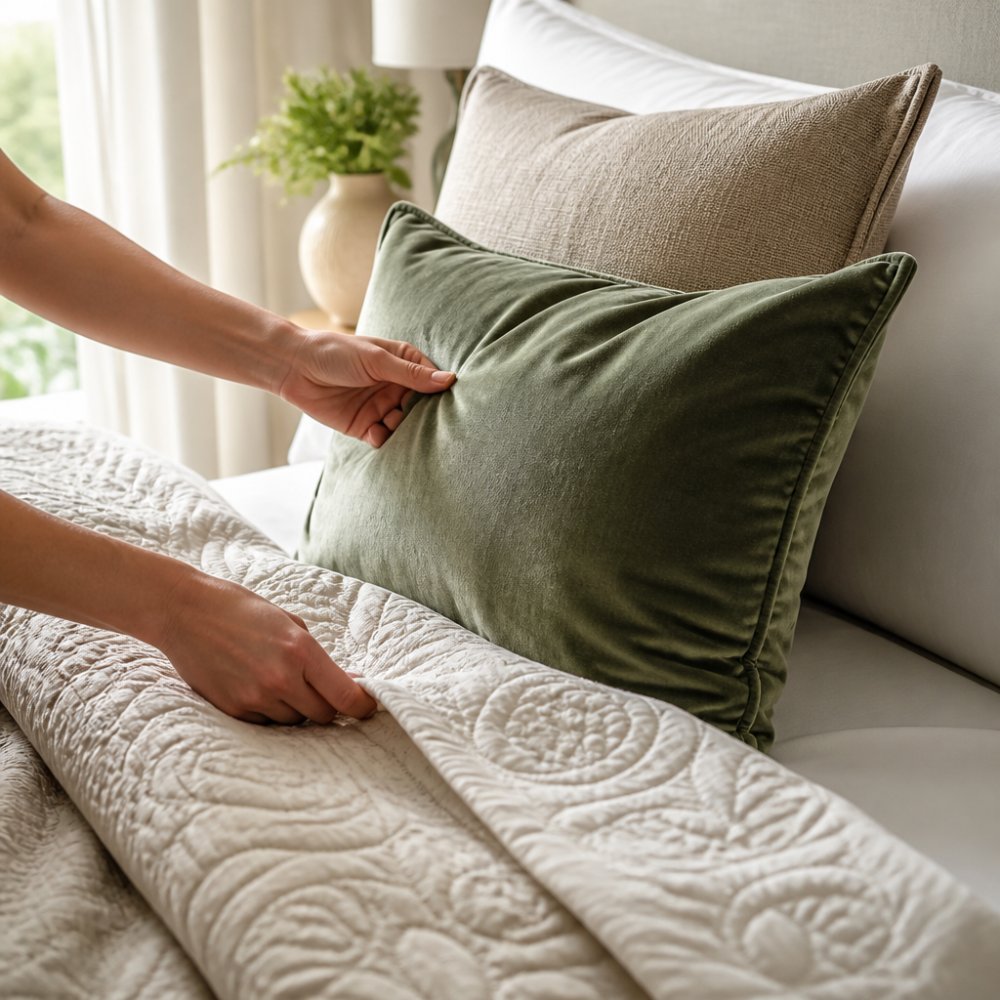
GSM (grams per square metre) is the single most useful number in home textiles, and almost no retailer volunteers it. Heavier fabric generally drapes better, resists pilling, and survives more wash cycles. Pick the piece up: a cushion insert that feels light and hollow will flatten within weeks, while a velvet throw with real weight to it holds its shape. If a product page does not state GSM or a comparable weight, treat that as a missing specification rather than a neutral one.
3. Construction Details and Finish
Turn the item over. Look at the seams, the zip, the hem, and the backing. Even stitching at a consistent stitch length, a concealed zip, and a lined or neatly bound underside signal a maker who expected the piece to be examined. Puckered seams, loose threads, and raw edges are the giveaway that corners were cut. On cushions, check whether the insert is feather, down, or polyester, the cover may be excellent while the insert is the weak point.
4. Colourfastness, Look for a Stated Test Method
Vague care labels ("cold wash") tell you little. A maker confident in its dye process will state a colourfastness rating or reference a standard test method, and will warn you specifically about fading, bleeding, or shrinkage. If the care information is silent on colour, assume the worst and wash separately for the first few cycles.
5. Underside Finish, The Tell Nobody Checks
The reverse of a cushion, the inside of a quilt cover, the base of a lamp: this is where cost-cutting hides. A lined or neatly finished reverse costs the maker more and signals a piece built to be lived with rather than photographed once.
The five-point check, summarised:
What to Check |
Weak Sign |
Strong Sign |
|---|---|---|
Fibre composition |
"Premium blend", vague labelling |
Named natural fibre, stated percentage |
Fabric weight |
No GSM given, feels light and hollow |
Stated GSM, substantial in the hand |
Construction |
Loose threads, raw edges, exposed zip |
Even seams, concealed zip, bound edges |
Colourfastness |
No care information provided |
Stated rating or test method, specific wash guidance |
Underside finish |
Unfinished backing |
Lined or neatly finished reverse |
Australian Competition and Consumer Commission guidance on country of origin and product claims
Cost Per Use of Home Decor Items: The Math That Matters
Cost per use is the purchase price divided by the number of times you actually use the item. A $299 quilt cover used every night for three years works out to well under a dollar a night. A $60 cover replaced twice over the same period costs more per night and delivers a worse experience the entire time.
Run the calculation before you buy, not after. Ask two questions: how often will this be used, and how long do I realistically expect it to last? The item that wins on both counts is the better purchase, regardless of which one is cheaper on the tag.
Adairs Alternatives for Luxury Home Textiles: What to Look For
If you are hunting for Adairs alternatives for luxury home textiles, the criteria matter more than the retailer. The mainstream homeware chains cover the mid-market well, but the gap they leave is in fibre quality, finishing, and how long a piece holds up under weekly washing.
Look for three things: a named natural fibre rather than a generic blend, a stated weight or density, and care instructions specific enough to suggest the maker tested the product. Vague labels like "premium blend" tell you nothing.
Our Taj Queen Quilt Cover Set is made from soft, durable cotton at $299, and the Marino Pillowcase at $35 pairs the same textured cotton with a finish that survives regular laundering. For living rooms, the Carla Blue Velvet Luxury Throw at $289 is sized at 140 by 240 centimetres, large enough to actually cover a sofa or a person. Free shipping applies on orders over $200.

Australian Competition and Consumer Commission guidance on country of origin and product claims
Investment Pieces vs Disposable Decor: Where to Splurge
Most guides frame this as taste: spend on what you love. That is not a decision rule. A more useful frame is total cost of ownership, the purchase price plus the replacement cost plus the care cost, divided across the years you actually keep the piece. Run that calculation and the splurge/save question mostly answers itself.
The Total Cost of Ownership Calculation
Take a quilt cover used every night. A $60 cover replaced twice over three years costs $180 in purchase price alone, plus the time and fuel of two extra shopping trips, plus the worse experience of sleeping under a thinning fabric for most of that period. A $299 cover used for the same three years costs $299 once. On a per-night basis the cheaper cover is not cheaper, it is a subscription you never agreed to, and the payments arrive as inconvenience rather than a direct debit.
The same logic applies to cushions on a main sofa, a throw used daily, and anything that touches skin. For purely decorative objects you look at but never handle, the calculation collapses and aesthetics can reasonably decide.
Where the Money Actually Goes
When you pay more for a well-made piece, the premium is not arbitrary. It typically funds:
- Named fibre rather than a generic synthetic blend, which resists pilling and holds colour longer
- Higher fabric weight (GSM), which drapes better and survives more wash cycles
- Finishing labour, concealed zips, bound edges, lined reverses, that adds cost per unit but removes the failure points that end a product's life early
- Smaller production runs, which is why timeless neutrals often cost more than trend colours produced at volume
None of this is visible on a product photo. It is visible in the third year of ownership.
A Practical Splurge/Save Rule
- Splurge: bedding you sleep in every night, the main sofa cushions, a throw used daily, anything that touches skin
- Save: seasonal accents, small decorative objects, trend-driven colour pops you may tire of
- Splurge: pieces with visible craftsmanship, such as a bound hem or a concealed zip
- Save: anything you would not notice if it disappeared
The Carla Black Cushion Feather at $119 is a good example of the middle ground: a single well-made velvet cushion in a neutral colour does more for a room than four cheap ones in a trend colour you will replace next year.

Resale Value and Sustainability: The Hidden Returns
Well-made decor holds resale value in a way mass-produced pieces do not. Solid timber, quality upholstery, and named natural fibres retain appeal in secondhand markets because buyers can verify what they are getting. Flat-pack and synthetic pieces generally do not.
There is a sustainability argument here too, and it is not just marketing language. A piece that lasts a decade replaces roughly ten disposable equivalents, which means less textile waste and fewer resources consumed per year of use. That is the practical case for buying well, and it holds whether or not you ever resell anything.
Australian Government Department of Climate Change, Energy, the Environment and Water on textile waste
Conclusion: Making Expensive Home Decor Worth It
Making expensive home decor worth it is not about spending more. It is about spending once on the pieces that earn their place through daily use, verifiable materials, and construction you can inspect.
If you are ready to upgrade the pieces you actually touch every day, Casa Sereno's curated collections cover quilt covers, throws, cushions, and pillowcases in timeless styles built for regular use. New subscribers get 20% off their first order, and shipping is free over $200.
Frequently Asked Questions
What is the 70/30 rule in decorating?
The 70/30 rule suggests spending 70% of your decor budget on foundational pieces like sofas, beds, and large rugs, and 30% on accents such as cushions, throws, and art. This balance ensures your space feels cohesive without overspending on trends. Applying this to expensive home decor means prioritising items you use daily, where cost per use drops over time.
How do you distinguish between luxury decor and overpriced items?
Luxury decor justifies its price through material composition, construction, and longevity. Look for solid wood grain, dense upholstery, and clean stitching. Overpriced items often rely on branding or trend appeal without these markers. A $289 velvet throw that lasts a decade costs less per use than a $60 throw replaced yearly. Check fibre content, weight, and finish before buying.
Does high-end home decor increase property value?
High-end decor rarely increases property value directly, but it can improve buyer perception and speed up a sale. Quality window treatments, lighting, and built-in storage add value. Freestanding decor like cushions and throws does not. Focus on investment pieces that stay with the home, and take your curated accents with you when you move.
What type of home decor sells the most?
Timeless textiles and functional decor sell most consistently. Quilt cover sets, cushions, throws, and tableware appeal to broad buyers because they are easy to style and replace. Trend-driven pieces have shorter shelf lives. For resale, neutral colours and classic materials like cotton, linen, and wool hold value better than bold seasonal prints.