Table of Contents
- What Makes Bedding Sustainable and Luxurious in 2026
- Benefits of Organic Cotton vs Bamboo Bedding
- GOTS Certified Bedding Australia: What the Labels Actually Mean
- How to Wash Luxury Linen Sheets Without Damaging Them
- The Environmental Impact of Textile Production and Microplastic Shedding
- End-of-Life Disposal and Circular Economy Options for Bedding
- Conclusion
- Frequently Asked Questions
Last Updated: September 11, 2026
What Makes Bedding Sustainable and Luxurious in 2026
Sustainable luxury bedding is bedding made from natural fibres that are certified to recognised environmental and social standards, produced through transparent supply chains, and designed to last for years rather than seasons. This guide from Casa Sereno examines what separates genuine sustainable luxury bedding from marketing copy, comparing organic cotton, bamboo, linen and other fibres on certification, care requirements and end-of-life disposal.
The word "luxury" has become almost meaningless on bedding labels. Any product can claim it. What cannot be faked is a certification number, a traceable fibre origin, or a fabric that still holds its drape after fifty washes. Those are the markers worth shopping by, and they are what this guide uses to separate the genuine from the rest.
Below, we break down how the major natural fibres compare, what each certification actually verifies, how to wash luxury linen sheets without wrecking them, and how to dispose of bedding responsibly when it finally wears out.
Benefits of Organic Cotton vs Bamboo Bedding
Organic cotton and bamboo bedding both offer breathability and a soft hand-feel, but they differ sharply in certification rigour, durability and environmental footprint. Organic cotton has the stronger verification framework; bamboo's advantages depend almost entirely on how it was processed.
How Organic Cotton and Bamboo Compare in Practice
Organic cotton is grown without synthetic pesticides and is typically certified through a chain-of-custody system that tracks the fibre from farm to finished product. It is hypoallergenic, breathable and gets softer with each wash. Its weakness is water intensity during cultivation.
Bamboo is naturally regenerative and grows quickly without replanting. The complication is processing. Bamboo viscose, the most common form, uses a chemical-heavy method that undercuts much of the environmental benefit. Tencel lyocell, a closed-loop alternative, recaptures and reuses the solvent, which is why it carries a stronger sustainability story.
Fibre |
Certification strength |
Durability |
Best for |
|---|---|---|---|
Organic cotton |
Strong, chain-of-custody |
High |
Year-round use, sensitive skin |
Bamboo viscose |
Weak to moderate |
Moderate |
Budget-conscious buyers |
Tencel lyocell |
Strong, closed-loop |
High |
Hot sleepers, humid climates |
French flax linen |
Strong, traceable |
Very high |
Warm climates, textured aesthetic |
GOTS Certified Bedding Australia: What the Labels Actually Mean
The Global Organic Textile Standard is the certification worth prioritising. It verifies organic fibre content, restricts chemical inputs, and sets minimum social criteria across the supply chain, including fair trade principles and a ban on child labour.
Look for the licence number on the label and verify it against the Global Organic Textile Standard public database. A product claiming "organic" without a traceable licence number is making an unverified claim.
OEKO-TEX Standard 100 and Other Certifications Worth Checking
OEKO-TEX Standard 100 tests the finished textile for harmful substances, including non-toxic dyes and residual chemicals. It does not verify organic farming, so it is a safety certification, not a sustainability one. The two are complementary.
Other labels worth checking include the Responsible Wool Standard, which covers animal welfare and land management, and Fair Trade certification, which addresses labour conditions. For Australian shoppers, the Australian Competition and Consumer Commission guidance on environmental claims is a useful reference: green claims must be substantiated, and vague terms like "eco-friendly" without evidence can breach consumer law.
How to Wash Luxury Linen Sheets Without Damaging Them
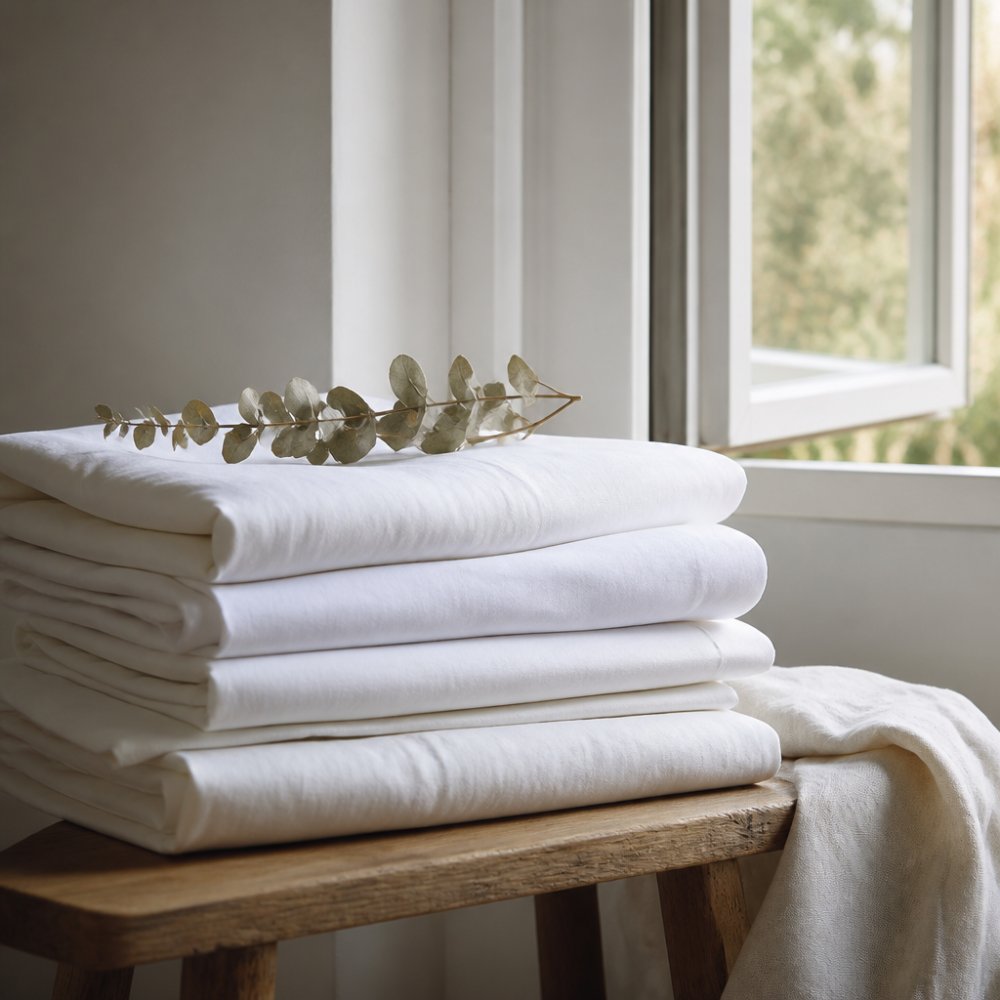
Wash linen and cotton bedding in cold water on a gentle cycle with a mild liquid detergent, then line dry in shade. Skip fabric softener entirely, as it coats the fibre and reduces breathability and moisture-wicking performance.
The practical routine:
- Wash separately from towels and denim to reduce abrasion
- Use cold water, never above 40°C
- Choose a gentle cycle with a low spin speed
- Line dry in shade to protect fibre strength
- Rotate between two sets so each rests between washes
A Simple Care Routine for Long-Term Bedding Longevity
Bedding longevity comes down to frequency and rotation. Wash every one to two weeks, rotate two or three sets, and store clean bedding folded in a dry cupboard away from direct sunlight.
A common mistake is over-washing. More frequent hot washes accelerate fibre breakdown faster than almost anything else. If you are coming from synthetic blends, expect natural fibres to feel stiffer for the first few washes before they relax into their true hand-feel.
The Environmental Impact of Textile Production and Microplastic Shedding
Textile production is one of the more resource-intensive manufacturing sectors, consuming significant water and energy and generating chemical runoff where regulation is weak. But "textiles use a lot of water" is not a useful shopping metric. What matters is which fibre, grown and processed how, and what it sheds over its life.
Where the Impact Actually Sits
Impact is not evenly distributed across a product's life. For natural-fibre bedding, the bulk of water and land use sits at cultivation; the bulk of energy and chemical risk sits at processing and dyeing. For synthetics, the dominant impact is upstream (petrochemical feedstock) plus a long tail of microfibre shedding during every wash.
- Cotton is water-intensive at cultivation, though rain-fed and organic systems reduce irrigation demand. Processing is comparatively simple.
- Linen (flax) is typically low-input, often rain-fed, and the whole plant is used, which lowers waste. Retting and spinning are the energy-intensive steps.
- Bamboo viscose carries a chemical-heavy processing burden; the solvent recovery rate is what separates a defensible product from a greenwashed one. Closed-loop lyocell recaptures and reuses the solvent, which is why it carries a stronger story.
- Polyester and polyester-cotton blends are the shedding problem. Easy-care and "wrinkle-free" finishes are usually the tell.
Microplastic Shedding: The Mechanism
Synthetic fabrics release microfibres, fragments under 5 mm, with mechanical and chemical stress during washing. Agitation, heat, detergent and spin speed all increase the rate. Because most washing machines discharge to wastewater treatment, and treatment does not fully capture fibres this small, a proportion reaches waterways. Research from the Australian Institute of Marine Science on microplastic pollution has documented microplastic accumulation in marine environments, and laundry is a recognised contributor.
Natural fibres shed too, but the fibres biodegrade rather than persisting. That is the core distinction: the issue is not shedding itself, it is persistence.
Reducing Shedding Without Replacing Your Machine
If you already own synthetic or blended bedding, the practical levers are:
- Wash less often. Every wash is a shedding event. Air and spot-clean between washes.
- Use cold water and a gentle cycle with a low spin speed.
- Fill the drum. A full load reduces the abrasion that generates fibres.
- Use a microfibre-catching wash bag or an inline filter where your machine or plumbing allows. These capture a meaningful share of what would otherwise discharge.
- Skip the dryer where possible; tumble drying abrades fibres and releases lint into the air.
- Choose 100% natural fibres at replacement time. This is the only lever that removes the shedding source entirely.
A Transparency Rubric for "Green" Claims
You cannot assess shedding or impact without knowing what is actually in the fabric. Use this to test a brand's claims before you buy:
- Fibre composition, stated precisely. "Bamboo" is not enough, ask whether it is viscose or lyocell, and where the solvent recovery sits.
- Certification with a verifiable licence number. A claim you cannot look up is not evidence.
- Processing disclosure. Which method, which mill, which country. Vague "responsibly made" language is a red flag.
- Supply chain traceability. Can the brand name the farm, spinner or mill? Chain-of-custody certification implies they can.
- End-of-life honesty. Does the brand tell you what happens when the product wears out, or does it stop at the sale?
If a brand cannot answer two or three of these, treat the sustainability claim as marketing until proven otherwise.
End-of-Life Disposal and Circular Economy Options for Bedding
Most bedding guides stop at the checkout. True sustainability runs the full lifecycle, and end-of-life is where natural-fibre bedding either closes the loop or quietly becomes landfill. The practical question is not "can I recycle this?" but "what is this product actually made of, down to the thread and the elastic?"
Why Most Bedding Cannot Be Composted
A quilt cover can be 100% organic cotton and still fail a compost test. Biodegradability is a property of the whole assembly, not the headline fabric. The usual blockers:

- Polyester or nylon thread in the seams, invisible, non-biodegradable, and present in most mass-market bedding even when the shell is natural.
- Elastic corners and fitted-sheet bands, synthetic rubber that will not break down and contaminates compost.
- Synthetic binding, piping or trim on coverlets and quilt edges.
- Blended weaves, a 95% cotton / 5% elastane sheet is not compostable, and the blend also complicates textile recycling.
- Dyes and finishes, some reactive dyes and easy-care resins leave residues that make home composting questionable.
If circularity matters to you, the check happens before purchase: look for 100% single-fibre construction, natural-fibre stitching, and no elastic. A pure linen flat sheet with cotton thread is genuinely compostable; a fitted sheet with an elastic band is not.
A Practical End-of-Life Hierarchy
Work down this order rather than defaulting to the bin:
- Reuse in the home. Worn sheets become drop sheets, garden frost covers, rag stock, or pet bedding. This is the lowest-effort, lowest-impact option and should be exhausted first.
- Donate intact sets. Clean, unstained sets with no tears are accepted by charity op shops. Fitted sheets with stretched or perished elastic are usually refused, remove the elastic or donate only flat sheets and quilt covers.
- Textile take-back and recycling. Some retailers and brands run in-store take-back for any brand of bedding; the collected textile is sorted into fibre streams. Check whether the scheme accepts blended or elasticised items, because many do not. Local council transfer stations and community recycling centres increasingly host textile drop-off points separate from general recycling.
- Compost only what qualifies. Pure cotton or linen, undyed or naturally dyed, with no elastic, no synthetic thread and no synthetic trim. Cut out seams and hems if you are unsure of the thread. Home compost is realistic for a single flat sheet; industrial composting is not widely available for textiles.
- General waste is the last resort, and for synthetic-blended bedding, it is effectively permanent. Polyester does not meaningfully degrade, so a discarded microfibre quilt cover persists for centuries.
The Circularity Trade-Off Nobody Prices In
Circularity and durability pull in the same direction: the longer a set stays in use, the smaller its annual footprint, regardless of what happens at the end. That is why rotation (two or three sets in service) beats buying one "eco" set and replacing it every year. It is also why repairability matters, a re-stitched seam or a replaced button extends life far more cheaply than a new purchase.
The honest limitation: textile-to-textile recycling for bedding is still immature, and most collected bedding is downcycled into insulation, wiping cloths or industrial felt rather than new sheets. Treat recycling as a backstop, not a plan. The plan is to buy single-fibre, keep it in use for a decade, then compost or donate what remains.
Conclusion
Choosing sustainable luxury bedding in 2026 comes down to three verifiable things: certified fibre, honest processing disclosure, and construction that will survive a decade of washing. Everything else is marketing. At Casa Sereno, our cotton quilt cover sets and bedspreads are designed to hold their look rather than chase a trend. Start with the Taj Queen Quilt Cover Set or the Olivia Coverlet to see the difference considered construction makes. Sign up and get 20% off your first order, with free shipping on orders over $200.

Frequently Asked Questions
What makes bedding truly sustainable in 2026?
Sustainable luxury bedding rests on three pillars: certified organic raw materials such as GOTS certified cotton or European flax linen, ethical manufacturing with non-toxic dyes and fair trade labour, and end-of-life planning so the product biodegrades or re-enters the circular economy. A product is only as sustainable as its weakest link, so supply chain transparency from farm to finished quilt cover matters as much as the fibre itself.
How do I identify high-quality sustainable linen?
Look for French flax or European flax origin, a visible OEKO-TEX Standard 100 or GOTS certification, and a weave density you can feel. Quality linen has a slight irregular slub, softens with every wash, and drapes heavily rather than stiffly. Ask the retailer for fibre origin and dye information; if they cannot answer, the 'sustainable' claim is probably marketing language rather than verified sourcing.
Are organic cotton and bamboo bedding considered luxury?
Yes, both can sit in the luxury category when the fibre quality and finishing are high. Organic cotton with long-staple fibres and a high thread count gives a crisp, hotel-style feel. Bamboo viscose or Tencel lyocell offers a silkier hand-feel and strong moisture-wicking, which suits warm sleepers. The luxury difference comes from fibre length, weave density and finishing, not the fibre name alone.
How should I care for sustainable luxury bedding to ensure longevity?
Wash linen and organic cotton in cool water with a gentle, pH-neutral detergent, avoid fabric softener, and tumble dry on low or line dry in shade. Rotate two sets so each rests between uses, and store folded in a dry cupboard rather than compressed. This routine protects natural fibres, limits pilling, and can extend bedding longevity well beyond the average two to three years.
What certifications should I look for when buying eco-friendly bedding?
GOTS certified bedding verifies organic fibre content, ethical processing and restricted chemical use across the whole supply chain. OEKO-TEX Standard 100 confirms the finished textile is free from harmful substances. For Australian buyers, also check whether the brand publishes supply chain transparency metrics such as farm origin, mill location and dye compliance, since these show real accountability rather than a logo on a swing tag.
Does bamboo bedding shed microplastics when washed?
Bamboo viscose and other regenerated cellulose fibres can shed microfibres during washing, though far fewer than polyester or acrylic. The volume depends on fibre length, weave density and wash cycle. Using a Guppyfriend-style wash bag, washing less often, and choosing longer-staple lyocell (Tencel) rather than short-staple viscose all reduce shedding and keep fibres out of waterways.
Can I recycle or compost old bedding at the end of its life?
Untreated, non-toxic-dyed natural fibre bedding such as cotton, linen and wool can be composted at commercial facilities or cut into cleaning rags for a second life. Blended fabrics and synthetic-filled quilts are harder to process and usually go to textile recycling schemes instead. Before discarding, check whether the brand runs a take-back or circular economy program, as more retailers now accept worn bedding for fibre recovery.
Is sustainable luxury bedding worth the higher price?
The higher price reflects certified fibre, ethical manufacturing and textile durability. Add the health benefit of non-toxic dyes and hypoallergenic fibres, and the value becomes clearer over the product's full lifecycle.