Table of Contents
- The Real Cost of Linen Bedding: What You're Paying For
- Benefits of Flax Linen Sheets: Breathability and Beyond
- Linen vs Cotton Sheets: Which Suits Your Sleep?
- Durability and Longevity: How Linen Softens Over Time
- How to Care for Linen Bedding to Protect Your Investment
- Environmental Impact and End-of-Life: Repair and Upcycling
- Cost-Per-Use Analysis: When Linen Bedding Pays for Itself
- Frequently Asked Questions
Last Updated: September 12, 2026
The Real Cost of Linen Bedding: What You're Paying For
Linen bedding is woven from flax plant fibres, and its higher price reflects a slower, more selective production process than cotton. Whether linen bedding is worth the cost depends on how you sleep and how long you plan to keep it.
Flax yields fibre from the stem rather than a boll, and separating it takes more handling than ginning cotton, so that labour sits in the price tag before the fabric is woven.
What you're actually paying for breaks down into three things:
- Fibre length. Longer flax fibres spin into stronger yarn, which is why quality linen resists pilling better than short-staple cotton.
- Weave density. A tighter, more even weave determines how the fabric drapes and how long it survives washing.
- Finishing. Stone-washing and garment-dyeing add cost but remove the stiff, papery feel of untreated linen.
Cheap linen cuts all three, the most common mistake buyers make.
Benefits of Flax Linen Sheets: Breathability and Beyond
The main benefit of flax linen sheets is thermoregulation: linen moves moisture away from your skin and releases it into the air faster than cotton, which changes how a night feels for a hot sleeper.
Flax fibres are hollow, so air passes through the fabric rather than sitting against you. When you sweat, linen wicks moisture to the surface where it evaporates; cotton holds it longer, which is why cotton sheets can feel clammy by 3am.
Beyond temperature, linen brings a few quieter advantages:
- Hand-feel. The fabric has a natural texture that stays cool to the touch, even in summer.
- Hypoallergenic properties. Linen's smooth, low-lint surface is often kinder to sensitive skin than fuzzy weaves, and it resists dust mite buildup better than dense cotton.
- Weight without heat. Linen has body. It drapes and stays put without trapping warmth.
If you wake up overheated or change the sheets more often in summer, linen addresses the cause, not the symptom.
Linen vs Cotton Sheets: Which Suits Your Sleep?
Linen wins on breathability, durability and long-term feel; cotton wins on upfront price, initial softness and wrinkle resistance. Which suits you depends on whether you're optimising for the next six months or six years.
The Australian Competition and Consumer Commission guidance on country of origin claims is worth checking if a retailer markets linen as "European flax," because origin claims are regulated. Beyond labelling, the practical differences are straightforward.
Factor |
Linen |
Cotton |
|---|---|---|
Breathability |
High, hollow fibres |
Moderate |
Moisture-wicking |
Fast drying |
Slower |
Initial softness |
Firmer, softens over time |
Soft immediately |
Wrinkling |
Creases naturally |
More wrinkle-resistant |
Lifespan |
Longer with care |
Shorter |
Upfront cost |
Higher |
Lower |
Cotton isn't the lesser choice, just the easier one: if you want bedding that feels broken-in on night one and don't mind replacing it sooner, cotton does the job.
Thread Count vs GSM: The Quality Metric That Matters
GSM (grams per square metre) measures fabric weight and density, and it tells you more about linen quality than thread count ever will. Thread count is a cotton metric that becomes meaningless for linen, because linen yarns are thicker and the count is naturally lower.
A mid-weight linen around 165-190 GSM drapes well and works year-round. Lighter weights feel airier in summer but crease more; heavier weights feel substantial but can sleep warm. When comparing linen bedding, ask for GSM, not thread count.
Durability and Longevity: How Linen Softens Over Time
Linen gets better with use, not worse. Each wash relaxes the fibres and breaks down the natural pectins that make new linen feel stiff, so it softens over the first year or two.
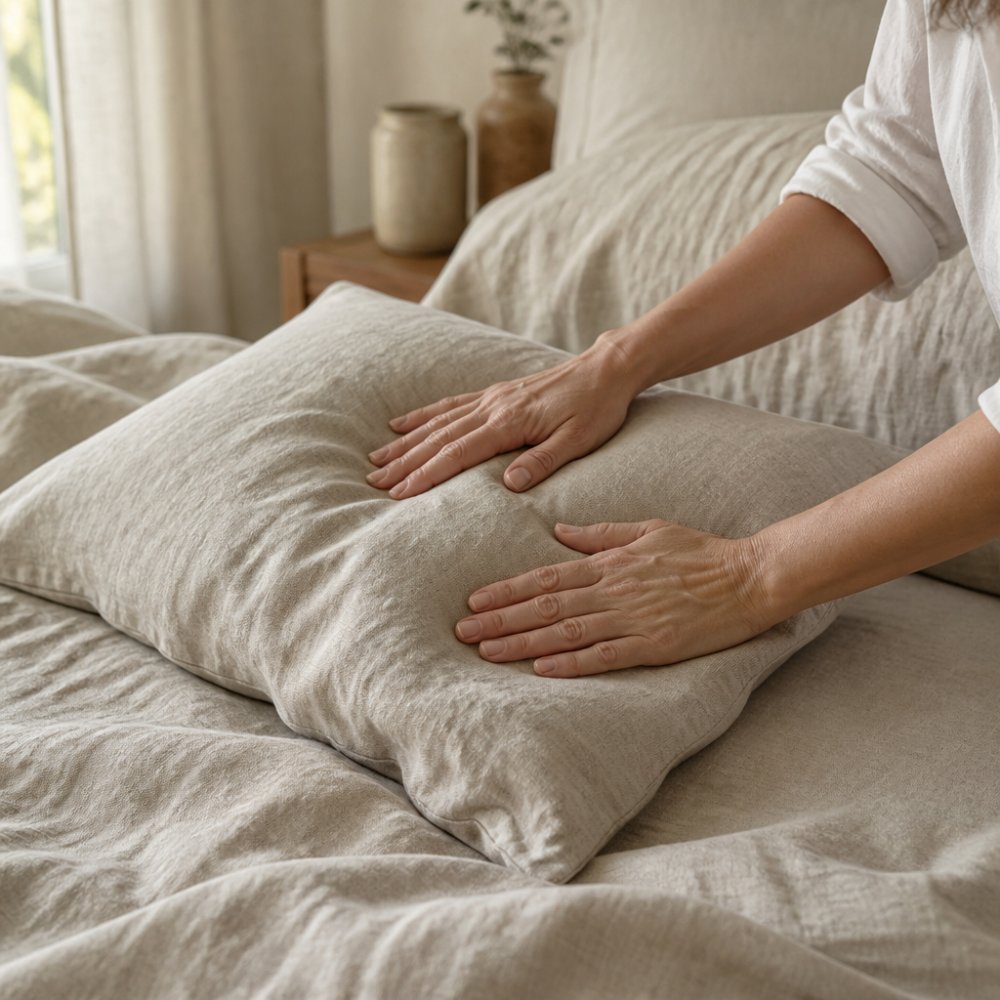
Close-up of hands feeling the soft, textured surface of a linen pillowcase on a bed, with natural light highlighting the fabric weave
That's the opposite of cotton, which starts at peak softness and degrades. Flax fibres also have higher tensile strength when wet than dry, which is why linen survives repeated laundering better than most cotton weaves.
The first three washes are the worst, new linen feels almost rough. Push through, and by month six it's the softest bedding you own.
How to Judge Durability Before You Buy
Softening is only half the story; the other half is whether the set survives to peak softness. Three signals separate linen that lasts a decade from linen that thins in two years:
- GSM in the 165-190 range. Below roughly 150 GSM, the fabric is too light to survive years of washing without developing thin patches, especially in the fitted sheet where stress concentrates. Above 200 GSM, you trade breathability for heft.
- Long-staple flax, not blends. Short fibres and cotton blends pill and shed. A retailer who can confirm it's 100% flax is giving you a durability signal; one who can't is not.
- Even weave with no slubs. Hold the fabric to light. Gaps, thin spots or visible slubs are where the first tears will appear.
Among long-term linen owners, the flat sheet and pillowcases typically outlast the fitted sheet by years, because the fitted sheet takes the stress of the mattress corners. That shapes how you replace pieces.
Repair and Upcycling: Extending Life Beyond the Decade Claim
Linen's longevity is not passive, it's maintained. A small tear patched in year three is the difference between a set that reaches year ten and one retired at year four.
Practical repairs that work on linen specifically:
- Darning small holes with matching thread while the fabric is still damp. Linen's wet strength means the repair sits flush and the surrounding weave holds.
- Reinforcing worn fitted-sheet corners with a fabric patch before they split. Corners fail first because they take the most tension.
- Re-stitching seams that have pulled, rather than replacing the whole set. Linen seams often outlast the fabric, so a re-stitch is cheap insurance.
When a piece is past bedding use, linen has a longer second life than cotton:
- Cushion covers cut from a flat sheet that's thinned in the middle but sound at the edges.
- Table runners and napkins from pillowcase fabric, which is usually the least worn part of a set.
- Cleaning cloths for the final stage, when the fabric is soft but no longer structural.
- Composting the remnants, since pure linen is biodegradable. Check whether your local council accepts textile waste in its organics stream before adding it.
A set that lasts a decade, gets patched twice, then becomes cushion covers has a very different footprint from three cotton sets that each last three years.
How to Care for Linen Bedding to Protect Your Investment
Caring for linen bedding comes down to three rules: wash cool, dry gently, and skip the fabric softener.
The Australian Textile Mills care labelling guide sets out the standard care symbols you'll find on bedding tags, and linen is usually marked for a gentle machine wash. Here's the routine that works:
- Wash at 30°C or cooler on a gentle cycle with a mild detergent.
- Skip fabric softener entirely. It coats the fibres and blocks the breathability you paid for.
- Line dry or tumble on low. High heat shrinks flax fibres and weakens them over time.
- Wash separately from heavy items like towels or denim, which abrade the weave.
- Rotate two sets if you can, so each set rests between washes.
Wrinkles are part of linen's character, not a defect. For a smoother look, remove it from the dryer slightly damp and smooth by hand. Ironing on medium works, but it's optional.
Environmental Impact and End-of-Life: Repair and Upcycling
Flax is one of the lower-impact fibre crops, largely because it grows with minimal irrigation and fewer inputs than conventional cotton, but that holds up only if you look at the whole lifecycle, not the field stage alone.
The Lifecycle Comparison, Stage by Stage
The useful version of the sustainability claim breaks it into stages, because linen doesn't win every one.
- Cultivation. Flax is typically rain-fed in the cool, damp regions where it's grown, so it needs far less irrigation than conventional cotton, which is often grown in water-stressed regions and irrigated heavily. Flax also tolerates denser planting with fewer pesticide inputs, though 'fewer' is not 'none', organic certification is what actually guarantees the difference.
- Processing. Here linen loses ground. Retting and separating flax fibres is more mechanical and energy-intensive than ginning cotton, and the fibre yield per hectare is lower. That's part of why linen costs more, and it's a real environmental cost, not a marketing footnote.
- Use phase. This is where linen's advantage compounds. A set that lasts eight to ten years replaces three or four cotton sets over the same period. Every replacement avoided is a full production cycle avoided, water, energy, dye, shipping and packaging included.
- End of life. Pure linen is biodegradable and, unlike polyester-cotton blends, doesn't shed microplastics with every wash. That matters more than most buyers realise, because synthetic blends are a documented source of microfibre pollution in waterways.
In lifecycle comparisons, the use phase dominates the total footprint for bedding, which makes longevity the biggest environmental lever a buyer has, bigger than fibre choice or organic certification.
What to Actually Look For
Sustainability claims on bedding are often made, so the labels that carry weight are the specific ones:
- OEKO-TEX Standard 100 for chemical safety in the finished textile.
- European Flax certification, which covers cultivation practice rather than just origin.
- GOTS if the linen is also organic, though it's less common for flax than for cotton.
Vague terms like 'eco-friendly' or 'natural' carry no verification behind them.
Repair and Upcycling: The End-of-Life Stage Competitors Skip
Linen is biodegradable, so it breaks down at end of life rather than persisting like synthetic blends. Better still, it can be repaired and repurposed long before that, and every year of extended use is a year of avoided production.
Practical second lives for worn linen:
- Patch and re-stitch small tears rather than replacing the whole set.
- Cut down to cushion covers when a fitted sheet wears thin in the middle.
- Repurpose as cleaning cloths once the fabric is too worn for the bed.
- Compost the final remnants if your local council accepts textile waste.
A set of linen bedding that lasts a decade and then becomes cushion covers has a very different footprint from three sets of cotton that each last three years.
Cost-Per-Use Analysis: When Linen Bedding Pays for Itself
Cost-per-use is where linen bedding justifies its price: divide the purchase price by the number of nights you sleep on it.
A mid-range linen set that lasts eight years delivers roughly 2,900 nights of use, cents per night even at a premium upfront price. A cheaper cotton set replaced every two years costs more per night by year four, because you've bought it twice.
Here's the framework to run your own numbers:
Factor |
Linen Set |
Cotton Set |
|---|---|---|
Typical lifespan |
6-10 years |
2-4 years |
Replacement frequency |
Rare |
Frequent |
Cost per night (long run) |
Lower |
Higher |
Softness trend |
Improves |
Declines |
Two caveats. First, this only works if you care for the linen properly. A set washed in hot water with softener will not last eight years. Second, if you change your décor every couple of years, the longevity advantage disappears.
For a coordinated finish that extends the life of your bed linen, Casa Sereno's Linen European - Ivory at $55.00 and the Linen European Sham - Charcoal at $85.00 layer well over a linen base and can be rotated to reduce wear on any single piece.

Linen European - Ivory
The challenge with linen isn't the price, it's committing to a fibre that rewards patience. Buy it expecting instant softness and you'll be disappointed. Buy it as a long-term piece and it becomes the best-value bedding you own. Casa Sereno's curated linen range, from the Linen European Feather Filled at $110.00 to the Linen Pillowcase - Blue at $35.00, is built for that kind of investment, with free shipping on orders over $200 and 20% off your first order when you subscribe. Get started with Casa Sereno and build a bedroom that softens with every year you keep it.


Frequently Asked Questions
Why is linen bedding so expensive compared to cotton?
Linen bedding costs more because of the labour-intensive process of turning flax plant fibres into fabric. Flax requires specific growing conditions and the fibres are harvested, retted, and woven in a way that preserves their natural strength. This results in a durable material that lasts for years, often outlasting cotton sheets. The upfront cost reflects the fibre quality, the weaving method, and the fact that linen is a long-term investment piece rather than a frequent replacement.
Does linen bedding get softer over time?
Yes, linen bedding goes through a natural softening process with every wash. The fibres relax and the fabric develops a softer hand-feel without losing its tensile strength. Many people find that linen becomes more comfortable after five to ten washes. To help it along, use a gentle wash cycle with mild detergent and avoid fabric softeners, which can coat the fibres and reduce breathability. This softening is one reason linen is often described as an investment that improves with age.
Is linen better than cotton for hot sleepers?
Linen is often a better choice for hot sleepers because of its breathability and moisture-wicking properties. The hollow fibres of flax allow air to circulate and pull moisture away from the skin, which helps with thermoregulation during the night. Cotton can also be breathable, but linen's natural texture and fibre structure make it more effective at keeping you cool and dry. If you experience night sweats, linen bedding can help regulate your temperature without feeling clammy.
How long does high-quality linen bedding last?
High-quality linen bedding can last for many years, often a decade or more with proper care. The durability comes from the tensile strength of flax fibres, which are stronger than cotton when wet. To extend its life, rotate between two sets, wash on a gentle cycle, and avoid overdrying. Repairing small tears or upcycling worn pieces into cushion covers or cleaning cloths can further delay replacement. This longevity is central to the cost-per-use argument for linen bedding.